
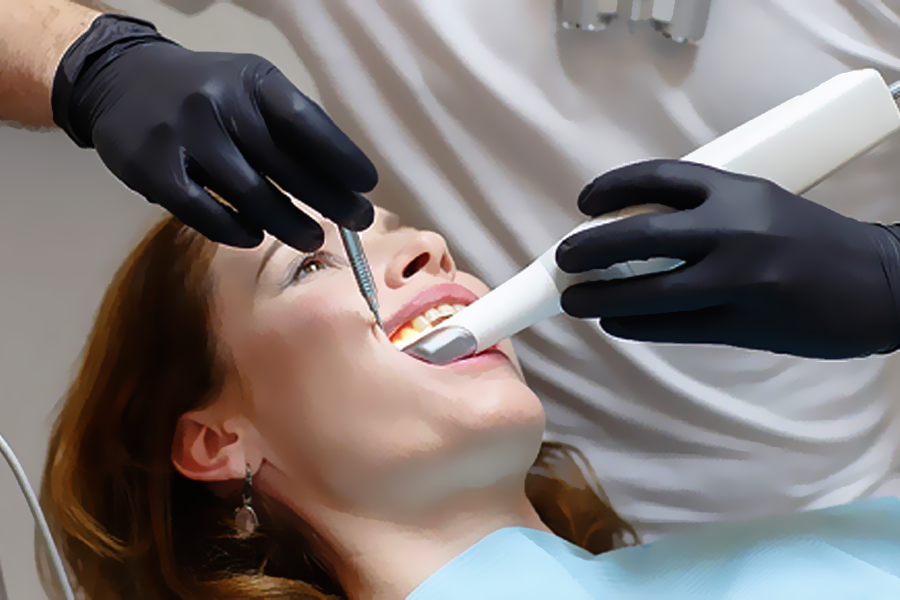
Digital Impression (Intraoral Scanner) Technology and Modern Dentistry
The world of dentistry is undergoing a revolutionary transformation, with traditional methods rapidly being replaced by digital solutions. At the heart of this transformation are “Digital Impression” technologies, which both simplify the dentist’s workflow and maximize patient comfort. Past, dough-like impression materials, a major fear for patients and a trigger for gag reflexes, have been replaced by cameras operating with millimeter precision. Dentocare, a pioneer in digital dentistry applications in the Kahramanmaraş region, integrates intraoral scanner technology into all treatment protocols, offering its patients a cutting-edge experience.
What is Digital Impression (Intraoral Scanner)?
Digital impression is the process of creating 3D virtual models of teeth and gums by scanning them with advanced optical cameras without using a physical molding material. In dentistry, devices called “Intraoral Scanners” take thousands of photos per second by being moved around inside the mouth with their pen-sized tips. These photos are combined by powerful software and displayed instantly on a computer screen. The resulting image is an exact digital copy of the patient’s oral structure. This technology forms the first and most important step of CAD/CAM (Computer-Aided Design and Manufacturing) systems.
How Does Intraoral Scanner Technology Work?
Intraoral scanners send beams of light (usually laser or structured light) to the tooth surface and calculate distances by analyzing the reflection of this light from the surface. The camera at the tip of the device creates a topographic map of the tooth, gum, and jaw closure. The state-of-the-art scanners used at Dentocare Kahramanmaraş clinic detect not only the shape of the teeth but also their true colors, creating high-resolution color models. Once the scanning process is complete, the resulting data (in STL, PLY, or OBJ format) is sent to the digital laboratory within seconds, and prosthesis production can begin.
Differences Between Digital and Traditional Impressions
The difference between traditional and digital methods is similar to the difference between analog and digital photography. In the traditional method, the impression material, placed in a metal spoon, is applied to the patient’s mouth and left to harden for minutes. This process is both prone to error and uncomfortable for the patient. In digital impressions, the process is entirely virtual, contactless, and fast. You can see the main differences between these two methods in detail in the table below:
| Features | Traditional Measurement (Spoon & Dough) | Digital Measurement (Intraoral Scanner) |
|---|---|---|
| Comfort | High risk of gag reflex, feeling of difficulty breathing | Comfortable, minimum risk of nausea, interrupted procedure can be performed |
| Speed | Waiting for the material to freeze (3-5 min) | Scanning within 1-2 minutes completed |
| Sensitivity | Risk of air bubbles, tearing and deformation | Micron level accuracy, error-free data |
| Communication | Measurement is sent to the laboratory by physical cargo (Time loss) | Data reaches the laboratory instantly (online) |
| Repeatability | If there is an error, the process is repeated from the beginning | Only the erroneous area is erased and rescanned |
The Place of Digital Impression in Dentistry
Digital impression forms the backbone of modern dentistry It is now used not only in prosthesis fabrication, but also in orthodontic clear aligner treatments, preparation of implant surgical guides, smile design simulations, and the production of sleep apnea devices. The digitalization of dentistry minimizes human error by standardizing the process from diagnosis to treatment completion. Dentocare increases predictability in treatments by making this technology an integral part of its clinical routines.
What are the Advantages of Digital Impression Taking?
Digital impression systems offer numerous advantages for both the dentist and the patient:
- High Accuracy: The shrinkage or expansion of traditional impression materials is eliminated, and prostheses fit perfectly on the tooth.
- Speed and Efficiency: The time spent in the chair is shortened, and treatment sessions are reduced.
- Environmentally Friendly: Plastic impression trays, chemical waste, and the use of plaster models are eliminated.
- Visual Communication: The patient participates more actively in the treatment process by seeing their own mouth in 3D and color on the screen.
Hygiene: ContactlessThanks to the transfer, the risk of cross-infection is minimized.
Comfortable Impression Process with Intraoral Scanner
For many patients, the most difficult part of sitting in the dentist’s chair is the large spoons placed inside the mouth and the impression materials that create a choking sensation. Intraoral scanners solve this problem completely. The tip of the device is quite small and moves comfortably inside the mouth. If the patient needs to rest during the scanning process, the process can be paused and continued from where it left off later. This feature provides great relief, especially for patients with claustrophobia or those experiencing a strong gag reflex. At Dentocare in Kahramanmaraş, patient comfort is paramount. How Long Does the Digital Impression Taking Process Take?
It takes an average of 60 seconds to 2 minutes for an experienced dentist to perform a full jaw scan. Taking the bite record (occlusion) takes place in seconds. While the preparation, application, freezing, and cleaning stages in the traditional method can take a total of 15-20 minutes, this time is dramatically shortened with digital imaging. This speed means significant time savings, especially for patients with busy schedules.
Is Digital Imaging Painful?
No, digital imaging is absolutely painless. The device does not damage the teeth or gums, and does not apply any pressure. Since the image is taken with only a light source, there is no need for anesthesia or numbing. It does not contain radiation (it is not an X-ray), it is a completely safe optical imaging method.
More Precise Treatment Planning with Digital Imaging
Planning done on 3D models provides much more detailed data than 2D X-rays. The dentist can examine the angle of the teeth to each other, the gum levels, the contact points with the opposing tooth from every angle on the screen, rotate the model, and take cross-sections. This detailed analysis ensures that the prosthesis or filling to be made is designed in the most biomechanically accurate way. At Dentocare Kahramanmaraş, “guessing” gives way to “mathematical precision”.
The Impact of Digital Impressions on Treatment Success
Treatment success is directly proportional to fit. The better the marginal fit of a porcelain veneer or implant-supported prosthesis, the lower the risk of bacterial leakage and the longer the life of the prosthesis. In restorations produced with digital impressions, fit is achieved at the micron level (thinner than a human hair). This accelerates the patient’s adaptation process to their new teeth and contributes to the protection of gum health in the long term.
Digital Impressions in Veneer and Prosthesis Treatments
Digital impressions are indispensable in zirconium, E-max (Laminate) or porcelain filling (inlay/onlay) applications. The scanned tooth is transmitted to the digital laboratory, where the prosthesis is designed using special design programs. Next, milling machines produce the prosthesis by milling the block of porcelain. This process is called “Digital Workflow.” The result is flawless prostheses that fit perfectly in one go, without the need for trial sessions.
Use of Digital Impressions in Orthodontic Treatments
The basis of clear aligner treatments, also known as wireless orthodontics, relies on digital impressions. After scanning the patient’s mouth, the movements of the teeth are planned step-by-step in a simulation program. The patient can see how their teeth will look at the end of the treatment on the screen even before starting treatment. Digital models can also be used to position brackets before traditional wires are fitted.
Advantage of Intraoral Scanners in Implant Treatments
When moving to the prosthetic stage after implant surgery, accurately transferring the position and angle of the implant is critically important. Using digital impression posts (scan bodies), the exact position of the implant is transferred to a digital environment. Furthermore, prior to surgery, the tomography data and intraoral scan data are superimposed to determine the ideal bone point for implant placement, and appropriate surgical guides are produced. This makes “Sutureless Implant” applications possible.
Reducing Error Margin with Digital Impressions
In manual impressions, many variables such as the dentist’s hand dexterity, the quality of the impression material, the mixing ratio, and expansions during plaster casting in the laboratory increase the risk of error. In digital systems, all these intermediate steps are eliminated. The data goes directly to the production device. Minimizing errors caused by the human factor forms the basis of the “zero error” principle at Dentocare Kahramanmaraş clinic.
Saving Time with Digital Impressions
Processes such as sending the impression to the laboratory by cargo, casting the plaster model, and allowing it to harden can take days. In digital impressions, data transfer is “instant”. The laboratory technician can start designing as soon as the dentist takes the impression. This significantly shortens prosthesis delivery times. In emergency situations or for patients with limited time, the “One Day Dentistry” concept can be implemented thanks to digital impressions.lass=”highlight-section”>
Patient Experience in the Digital Impression Process
The greatest awareness for our patients is that the process is interactive. When the scan is finished, the doctor turns the screen to the patient and explains the situation: “Look, you have tartar here, the edge of your filling is broken there, your teeth close like this.” This visual explanation allows the patient to become aware of their own oral health and increases their confidence in the treatment. At Dentocare, the patient is not a passive observer, but an active participant in the process.
Who is Digital Impression Suitable For?
Digital impression is suitable for patients of all ages who can open their mouths. Especially for:
- Those with an excessive gag reflex.
- Those who have difficulty keeping their mouths open for extended periods (those with temporomandibular joint disorders).
- Busy business people who want quick treatment.
- Those who are uncomfortable with the taste and smell of traditional impression materials.
- Patients who will undergo large and complex prosthetic treatments.
Digital Impression in Children and Sensitive Patients
Child patients may be afraid or uncomfortable with large spoons entering their mouths. Intraoral scanners, however, feel like a “technological game” to them and are much easier to adapt to. Furthermore, the speed and contactless nature of the procedure greatly facilitates the treatment process for disabled individuals or elderly patients.
Digital Archiving After Digital Impression
Traditional plaster models can break, get lost, or require large physical spaces for storage. Digital models are securely stored in computer environments or cloud systems. Years later, if a patient has a problem with their teeth or needs a new prosthesis, their old records can be accessed in seconds. This “Digital Memory” facilitates the monitoring of the patient’s oral health for many years.
Personalized Treatment Production with Digital Impressions
Digital data is combined with the patient’s facial photographs to create a “Digital Smile Design.” The tooth form most suitable to the patient’s facial features, expressions, and character is selected from thousands of options in the library or designed from scratch. This personalization ensures that a unique work of art, not a mass-produced tooth, is created.
Modern Technologies in Digital Impression Use
Artificial intelligence (AI) is also integrated into digital impression software. During scanning, the device automatically detects if the tongue or cheek obstructs the image and cleans up this unnecessary data. In addition, thanks to special light modes that can detect caries (such as NIRI technology), interproximal caries that are invisible to the naked eye can also be diagnosed during scanning. Dentocare Kahramanmaraş closely follows and incorporates these advanced technologies.
More Predictable Results with Digital Impressions
In traditional methods, there is always a risk of “surprises”; the prosthesis arrives but doesn’t fit, the color doesn’t match, or it’s too high. In the digital workflow, however, every step is under control. During the design phase, the contact points with the opposing tooth are adjusted with micron precision. The result is predictable for both the dentist and the patient, free from surprises, and satisfying.
Comfortable Treatment Process with Digital Impressions (Intraoral Scanner)
Digital impressions, one of the most beautiful points where technology meets health, transform the dental experience from a nightmare into a comfortable and exciting process. As Dentocare Kahramanmaraş, we offer our patients not only dental treatment but also a high-level technological experience. We open the doors of the digital world wide for a faster, more precise, more hygienic, and most importantly, more comfortable treatment process. Designing your smile with digital precision and getting acquainted with the future of dentistry is the right step towards a healthier tomorrow.