
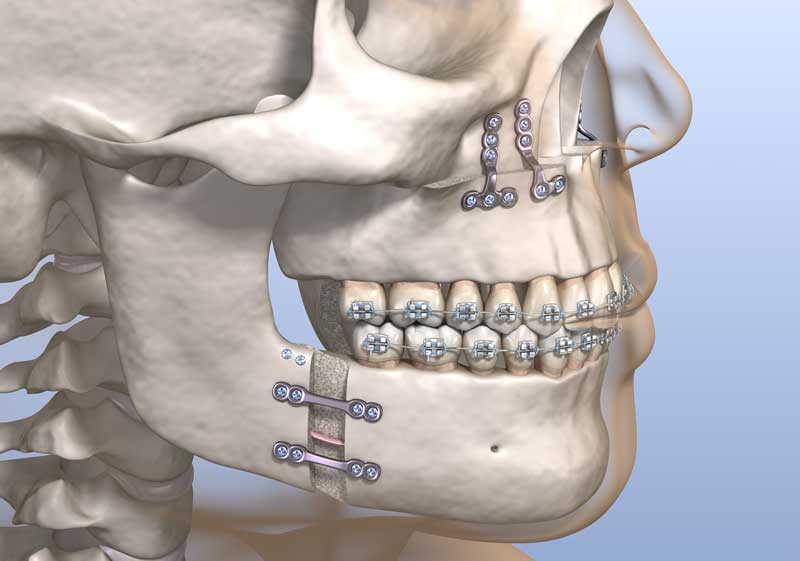
Maxillary Surgery: Balanced Transformation at the Heart of Facial Aesthetics
The maxilla, which forms the midline of the face and is a key point in aesthetic appearance, is a complex bone structure that directly affects not only the smile but also breathing, speech, nasal support, and the structure under the eyes. Developmental deficiencies, excessive growth, or asymmetrical positioning of the maxilla can lead to serious aesthetic losses and functional disorders in the facial profile. Dentocare, a pioneering visionary in the field of oral, dental, and maxillofacial surgery in Kahramanmaraş, solves these structural problems radically with “Maxillary Surgery” (Maxillary Osteotomy), restoring ideal facial proportions and healthy function to its patients. This procedure, one of the most delicate areas of orthognathic surgery, is implemented through a combination of scientific planning and an artistic perspective.
What is Maxillary Surgery?
Maxillary surgery, generally known in medical literature as “Le Fort I Osteotomy,” is the procedure of separating the upper jawbone from the base of the skull in a controlled manner and bringing it to its planned new position (forward, backward, upward, downward, or rotational). This surgical intervention not only corrects malocclusion but also reconstructs the skeletal support of the mid-face region. At Dentocare Kahramanmaraş clinic, this operation is combined with orthodontic treatment to ensure perfect balance of jaw and facial harmony. Maxillary surgery is not only an aesthetic operation but also a reconstructive procedure that opens the airway and improves chewing efficiency.
When is Maxillary Surgery Necessary?
This surgery becomes necessary when the extent of the skeletal disorder is too advanced to be corrected with braces or clear aligners (camouflage treatment) alone. The main conditions requiring surgery are:
- Maxillary Retrognathia (Upper Jaw Retraction): The upper jaw being set back relative to the face causes mid-face depression and a protruding lower jaw.
- Maxillary Prognathia (Upper Jaw Protrusion): Excessive protrusion of the upper jaw and a protruding appearance of the teeth.
- Gummy Smile: Excessive vertical growth of the upper jaw resulting in excessive gum visibility when smiling.
- Open Bite: The back teeth are in contact, but the front teeth do not touch each other, leaving a gap.
- Facial Asymmetry: Facial curvature caused by the upper jaw being tilted to the right or left (Canting).
- Sleep Apnea: Airway narrowing due to upper jaw retraction. and difficulty breathing.
The Effect of Upper Jaw Structure on Facial Aesthetics
The maxilla is the “keystone” of the face. It supports the area from below the eyes to the upper lips (midface). The position of the upper jaw determines the uplift of the nasal tip, the fullness of the cheeks, the support of the lips, and the depth of the nasolabial (narrow) lines. For example, in an individual with a receding upper jaw, the nose may appear larger than it is, and the cheeks may appear sunken. Dentocare specialists aim to improve facial aesthetics as a whole by taking into account not only the teeth but also these soft tissue changes when planning surgery.
What are Upper Jaw Disorders?
Disorders are examined in three planes: Sagittal (front-back), Vertical (vertical), and Transversal (horizontal). Problems in the front-back direction disrupt the relationship between the chin and the nose. Excesses in the vertical direction lead to “long face syndrome” and a gum smile, while deficiencies in the vertical direction cause an aged and edentulous appearance. Horizontal constrictions, on the other hand, cause crowding and dark areas in the lateral regions (buccal corridor).
The Role of Maxillofacial Surgery in Jaw Alignment Problems
The alignment (occlusion) between the upper and lower jaws is vital for the effectiveness of chewing, the first step of the digestive system. Maxillofacial surgery ensures ideal occlusion by aligning the upper dental arch with the lower dental arch. This alignment balances the loads on the temporomandibular joint (TMJ), prevents pathological wear on the teeth, and ensures correct articulation of sounds during speech. Surgery lays the foundation for healthy function, beyond an aesthetic smile.
Pre-Maxillofacial Surgery Examination and Evaluation
At Kahramanmaraş Dentocare, the process begins with a detailed clinical examination and analysis of patient expectations. The patient’s facial profile, smile line, gingival visibility, and lip support are examined. Nasal structure and respiratory function are evaluated. The orthodontist and oral surgeon jointly evaluate the patient and create a multidisciplinary roadmap.
Radiological and Clinical Analysis Process
Advanced imaging technologies are used in the diagnostic phase. In addition to standard panoramic X-rays, cephalometric analyses (lateral skull measurements) and, most importantly, 3D Cone Beam Computed Tomography (CBCT) are used to create a three-dimensional anatomy of the jaw.These images are extracted. Sinus cavities, tooth roots, and bone quality are measured millimeter by millimeter on these images. Intraoral recordings taken with digital scanners allow for the creation of virtual models.
Personalized Maxillofacial Surgery Planning
Every face has a different anatomy and aesthetic needs. The 3D surgical simulation software used at Dentocare allows for a virtual rehearsal of the operation. How many millimeters the upper jaw will be advanced, how much it will be impacted, or at what angle it will be rotated is planned on the computer. This “Virtual Surgery” makes the outcome of the operation predictable and gives the patient a realistic idea of how their face will look after the operation.
Maxillofacial Corrections within the Scope of Orthognathic Surgery
Maxillofacial surgery is usually performed in conjunction with orthodontic treatment. Before the operation, the teeth are straightened on the jawbone with braces. During the operation, the upper jawbone is cut at the level of the base of the nose (Le Fort I line) and brought to its planned new position. This new position is fixed with titanium plates and screws. These fixation materials are biocompatible and can last a lifetime.
Surgical Approaches to Maxillary Deflation and Protrusion
In maxillary deposition, the maxilla is advanced (Advancement) to fullen the midface and increase upper lip support. This procedure often also slightly lifts the tip of the nose. In maxillary protrusion, the bone segment is retracted (Setback), but this procedure is less frequently performed due to anatomical limitations. Maxillary deposition is generally a more common indication.
Surgical Treatment for Maxillary Asymmetries
In cases where the midline of the face is crooked or the smile plane (occlusal plane) is curved (Canting), maxillary leveling is performed. One side of the chin is recessed upwards while the other side is lowered downwards, bringing the plane parallel. This procedure dramatically improves facial symmetry and corrects the patient’s photogenic appearance.
How is Upper Jaw Surgery Performed?
The operation is performed entirely through the mouth, so there are no incision marks on the facial skin. The jawbone is accessed through an incision made under the upper lip. Bone cuts (osteotomy) are made precisely with ultrasonic piezo devices, thus minimizing the risk of soft tissue and nerve damage. After the jaw is brought to its new position, it is fixed with plates and screws, and the gums are closed with aesthetic sutures.
How Long Does Upper Jaw Surgery Take?
Operations involving only the upper jaw take an average of 1.5 – 2.5 hours. If combined with lower jaw (bimaxillary) or chin tip (genioplasty), the duration may be longer. Dentocare’s expert surgical team and modern technological equipment optimize the operation time, keeping the patient’s anesthesia time to a minimum.
Is Maxillofacial Surgery Performed Under General Anesthesia?
Yes, this comprehensive surgical procedure is performed under general anesthesia in a fully equipped hospital setting for patient safety and comfort. Kahramanmaraş Dentocare performs its operations in hospitals with the highest sterilization and intensive care standards, accompanied by expert anesthesia teams.
Is Maxillofacial Surgery Painful?
Pain is the biggest concern for patients. However, pain after maxillofacial surgery is surprisingly minimal. The temporary numbness of the nerves in the surgical area creates a natural painkiller effect. Any mild pain that may occur is easily controlled with simple painkillers given intravenously or taken orally.
Recovery Process After Maxillofacial Surgery
The recovery process is phased:
- Hospital Stay: Usually 1 or 2 nights in the hospital.
- Edema (Swelling): Swelling in the face is normal for the first 3 days and can be controlled with ice application. Most of the swelling subsides after 1 week.
- Bone Healing: Initial healing occurs in 4-6 weeks.
- Complete Healing: It may take up to 6 months for the soft tissues to settle and reach their final state.
Things to Consider After Maxillofacial Surgery
Nasal cleaning should be done carefully in the first few weeks, and blowing your nose should be avoided (due to sinus pressure). Oral hygiene is critical to prevent the risk of infection; Soft brushes and special mouthwashes should be used. Keeping the head elevated reduces swelling. Smoking is strictly prohibited as it impairs healing.
Nutrition Process After Maxillofacial Surgery
The jaws should not be subjected to pressure during healing. Liquid nutrition (protein drinks, soup, fruit juice) is applied for the first week. For the following 3-4 weeks, soft foods that do not require chewing (puree, yogurt, pudding) are consumed. After approximately 1.5 months, a gradual return to normal nutrition is possible.
Who is Suitable for Maxillofacial Surgery?
Those who have completed their growth and development (17-18 years old for women, 18-20 years old for men), have skeletal jaw problems, and have good general healthThe procedure is suitable for individuals who are amenable to anesthesia. Patients with “Gummy Smile,” those who appear older due to a receding upper jaw, or those with malocclusion are ideal candidates.
Balance of Aesthetics and Function in Maxillofacial Surgery
Dentocare’s philosophy does not separate aesthetics and function. When the upper jaw is brought forward, not only is lip support increased, but the airway is also widened, and the patient breathes more comfortably. When a gummy smile is corrected, not only is aesthetics improved, but lip closure is relaxed and mouth breathing is reduced. Every surgical procedure serves both beauty and health.
Chewing and Speech Function with Maxillofacial Surgery
In patients with jaw deformities, the pronunciation of some letters (s, z, f, v) may be impaired. After surgery, speech becomes clearer as the position of the tongue and teeth is corrected. In addition, when full contact of the teeth is achieved, biting and grinding functions are maximized, and digestive problems are reduced.
The Effect of Upper Jaw Surgery on Facial Profile
This surgery is one of the procedures that most dramatically and positively changes the facial profile. Bringing the upper jaw forward accentuates the cheekbones, supports the base of the nose, and plumps the upper lip. Under-eye hollows are reduced. Patients generally achieve a younger, more dynamic, and rested expression after the operation.
Comparison of Treatment Results
| Condition | Before Surgery | After Surgery |
|---|---|---|
| Upper Jaw Recession | Sunken midface, prominent lower jaw | Full cheeks, balanced profile |
| Gummy Smile | Excessive gum visibility, lip does not close | Ideal gum level, comfortable lip closure |
| Asymmetry | Curved smile line | Parallel and symmetrical smile |
Modern Surgical Techniques in Maxillofacial Surgery
Dentocare uses piezoelectric surgery (ultrasonic bone cutting) technology. This technology does not damage soft tissues, nerves, and blood vessels while cutting the bone. This minimizes the risk of postoperative swelling, bruising, and loss of sensation. In addition, surgical guides (splints) produced with 3D printers allow for micron-precision placement of the jaw.
Long-Term Results After Maxillofacial Surgery
The results obtained after bone healing are permanent. The jaw skeleton is fixed in its new position. However, adherence to the retention phase of orthodontic treatment and control of habits such as teeth grinding are important for the stability of the result.
A Balanced and Healthy Facial Structure with Maxillary Surgery
The balance in your face is a reflection of the balance in your life. Your maxillary problems can be a condition that affects your health beyond aesthetic concerns. At Kahramanmaraş Dentocare, we redesign the architecture of your face with advanced surgical techniques and digital planning. Discover the possibilities offered by maxillary surgery to breathe more easily, smile with confidence, and see ideal proportions when you look in the mirror. At the point where science and art meet, we design the best for you.