
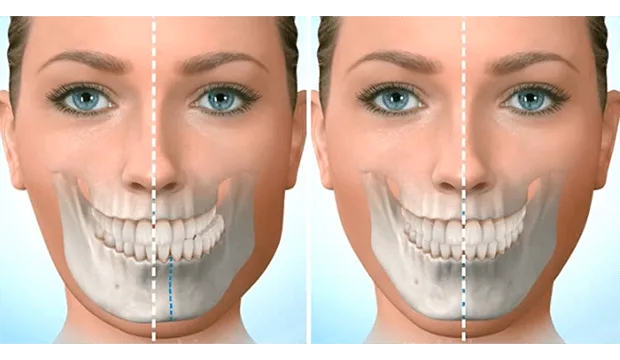
Double Jaw Surgery: The Perfect Balance of Facial Aesthetics and Function
The human face is not only the center of aesthetic perception but also the crossroads of vital functions (breathing, chewing, speaking). The upper and lower jaws, which form the skeletal structure of the face, must be in harmony with each other and with the base of the skull. However, when this harmony is disrupted as a result of developmental disorders, genetic factors, or traumas, serious aesthetic and functional problems arise. Dentocare, which provides services with advanced technologies in the field of oral, dental and maxillofacial surgery in Kahramanmaraş, offers permanent solutions to these complex problems with “Double Jaw Surgery” (Bimaxillary Orthognathic Surgery). This operation is not only about correcting the teeth but also about reconstructing the profile and skeletal structure of the face.
What are Double Jaw Surgeries?
Double jaw surgery, also known as “Bimaxillary Orthognathic Surgery” in medical literature, is a comprehensive procedure in which the lower jaw (mandible) and upper jaw (maxilla) are surgically moved to their ideal anatomical positions in the same operation session. It is applied in cases where single jaw surgeries are insufficient and the deformity affects both jaws. In this surgery, the upper jaw can be moved up, down, forward, or backward; and the lower jaw is repositioned accordingly. At Dentocare Kahramanmaraş clinic, this process is a treatment protocol requiring engineering precision, carried out in close collaboration between the orthodontist and oral surgeon.
In Which Cases Are Double Jaw Surgeries Necessary?
Double jaw surgery is mandatory in cases where the skeletal disorder is severe and correcting a single jaw cannot provide sufficient alignment (occlusion). It is particularly preferred in the following cases:
- Severe Skeletal Class 3 Anomaly: Cases where the lower jaw is excessively forward and the upper jaw is excessively backward.
- Severe Skeletal Class 2 Anomaly: Cases where the upper jaw is forward and the lower jaw is excessively backward, narrowing the airway.
- Long Face Syndrome: Cases where the vertical dimension of the face is excessively increased, the lips do not close, and there is a gummy smile.
- Facial Asymmetry: Cases where the chin is significantly shifted to the right or left and the upper jaw plane is curved (Canting).
- Open Bite: Skeletal cases where a large gap remains between the front teeth while the back teeth are in contact.
Lower and The Importance of Upper Jaw Alignment
Jaw alignment is critical for the effectiveness of chewing, the beginning of the digestive system. The upper and lower teeth must fit together like a “key and lock.” When this alignment is disrupted, excessive and unbalanced loads are placed on the temporomandibular joint (TMJ). Over time, this leads to joint pain, osteoarthritis, and clicking sounds. Jaw alignment also determines the width of the airway. Correct jaw positioning prevents respiratory problems such as sleep apnea. Dentocare focuses not only on aesthetics but also on this functional alignment in its treatments.
What are Jaw Alignment Disorders?
Alignment disorders are evaluated in three planes. In the sagittal plane (anterior-posterior), jaw protrusion or retrusion is observed; in the vertical plane (vertical), the face is excessively long or short; and in the transversal plane (horizontal), the jaws are narrow or asymmetry. In most patients, these problems are found in combination. For example, a patient with a protruding lower jaw may also have upper jaw narrowing and asymmetry. This complex condition can only be corrected holistically with double jaw surgery.
Double Jaw Surgery within the Scope of Orthognathic Surgery
Orthognathic surgery is a whole that includes the preparation phase with braces and the surgical phase. Double jaw surgery is the most important step in this process. Before the surgery, the teeth are brought to their ideal positions on the jaws (decompensation). During the surgery, the bones are moved. This process completely changes the profile of the face, lip support, nasal tip, and jawline. At Dentocare in Kahramanmaraş, this process aims to bring the patient’s facial proportions closer to the golden ratio.
What is the Purpose of Double Jaw Surgery?
The main goal is to offer the patient the most ideal result in terms of both function and aesthetics. Functionally, the aim is to increase chewing efficiency, correct speech disorders, protect temporomandibular joint health, and widen the airway. Aesthetically, the aim is to correct facial asymmetries, balance the profile, achieve smile aesthetics, and give the patient a younger, more dynamic appearance.
Examination and Evaluation Before Double Chin Surgery
The treatment process begins with a detailed clinical analysis. Dentocare specialists examine the patient’s face from the front and profile. The relationship between the lips and teeth, the smile line, the nasal structure, and the position of the chin are evaluated. Intraoral examination includes the occlusion of the teeth.Gum health is checked. The patient’s expectations are listened to, and realistic information is given about the limitations of the surgery.
Radiological and Digital Analysis Process
Advanced imaging methods are essential for diagnosis and planning. In addition to panoramic X-rays, cephalometric analyses and, most importantly, 3D Cone Beam Computed Tomography (CBCT) are used to create a precise three-dimensional model of the skull and jaws. On this model, the channels through which the nerves pass, bone thicknesses, and root positions are measured with millimeter precision.
Personalized Double Jaw Surgery Planning
In modern surgery, there is no room for “guessing.” At Dentocare, the surgery is performed virtually using 3D surgical simulation software. The number of millimeters by which the upper jaw will be embedded and the amount of rotation of the lower jaw are planned on the computer. Thanks to this planning, surgical guides (splints) to be used during the surgery are produced with 3D printers. Personalized planning ensures that the result is predictable and error-free.
How are Double Jaw Surgeries Performed?
The surgery is performed entirely through the mouth, leaving no incision scars on the face. “Le Fort I” osteotomies are used for the upper jaw, and “BSSO” (Sagittal Split) osteotomies for the lower jaw. The bones are cut and freed in a controlled manner, brought to the planned new position, and fixed with titanium plates and screws. These plates are tissue-friendly and can usually remain in place for life. At the end of the procedure, the jaws are connected with rubber bands to adapt to the new bite.
How Long Do Double Jaw Surgeries Take?
This operation is longer and more extensive than single jaw surgery. On average, it takes between 3 and 5 hours. The duration may vary depending on the complexity of the procedures, additional procedures (chin tip aesthetics, impacted tooth extraction, etc.), and the surgeon’s experience. Dentocare’s expert surgical team and modern operating room infrastructure ensure efficient use of time and optimization of the patient’s anesthesia time.
Are Double Jaw Surgeries Performed Under General Anesthesia?
Yes, double jaw surgery is a major operation and is always performed under general anesthesia in a fully equipped hospital setting for patient comfort and safety. Kahramanmaraş Dentocare conducts its operations in partner hospitals with intensive care units and advanced sterilization standards.
Are Double Jaw Surgeries Painful?
Patients’ biggest concern is pain. However, cutting the bones during surgery creates temporary numbness (paresthesia) in the nerves. This provides a natural anesthetic effect in the first few days after surgery and suppresses pain. Mild pain that may occur is easily controlled with painkillers administered intravenously. Our patients usually mention a feeling of tension in the face rather than pain.
Recovery Process After Double Jaw Surgery
The recovery process requires patience:
- Hospital Stay: Usually 2 nights in the hospital.
- First Week: Swelling (edema) occurs in the face, this is expected. It is controlled with ice application.
- Nutrition: Liquid nutrition is applied for the first week, then pureed nutrition for the next 3 weeks.
- Use of Elastics: Elastics are used to accustom the jaws to the new position.
- Social Life: School or work life can be resumed after approximately 2-3 weeks.
Things to Consider After Double Jaw Surgery
Oral hygiene is the most important factor to prevent the risk of infection. Baby toothbrushes and special mouthwashes should be used. Nasal cleaning should be done gently; blowing your nose should be avoided. Keeping the head elevated reduces swelling. Smoking is strictly prohibited as it impairs bone healing and blood flow.
Nutrition Process After Double Chin Surgery
Since the jaws should not be subjected to pressure, the first week is spent eating soups without solid particles, protein drinks, and fruit juices. From the second week onwards, soft foods that do not require chewing (mashed potatoes, yogurt, soft-boiled eggs) are introduced. After approximately the 6th week, as bone healing progresses, a gradual transition to normal nutrition (first soft, then hard) begins.
Who is Suitable for Double Chin Surgery?
It is suitable for individuals who have completed their skeletal development (17-18 years old for women, 18-20 years old for men), have severe jaw deformities, and whose general health condition is suitable for anesthesia. Patients with malocclusion that cannot be corrected with braces, facial asymmetries, and sleep apnea are ideal candidates.
Balance Between Aesthetics and Function in Double Chin Surgery
Double chin surgery is the area where aesthetics and function are most intertwined. When the jaws are brought into the correct occlusion (function), the facial profile is automatically corrected (aesthetics). Bringing the upper jaw forward makes the cheeks fuller, and correcting the lower jaw eliminates the double chin. Dentocare’s philosophy is to maximize both elements.
Double Chin Surgery
Improvement of Chewing Function with Double Jaw Surgery
Patients with jaw deformities often chew only with their back teeth or unilaterally. The biting (tear-off) function with the front teeth may be lost. When contact between all teeth is achieved after surgery, chewing efficiency reaches 100%. Digestive problems decrease, and the load on the temporomandibular joint is balanced.
The Effect of Double Jaw Surgery on Speech
The position of the teeth and jaws determines the range of motion of the tongue in the mouth. In patients with open bite or jaw retrusion, the pronunciation of letters such as “s, z, f, v” may be impaired (lisping). Since the anatomical structure is corrected after surgery, speech articulation also improves spontaneously or with a short therapy.
Contribution of Double Jaw Surgery to Facial Aesthetics
This surgery creates dramatic and positive changes in the facial profile. The sunken mid-face appearance is eliminated, nasal support is increased, and the chin becomes more prominent or refined by filing. Correcting facial asymmetry improves the patient’s photogenic appearance and self-confidence. Our patients generally achieve a “younger and more rested” expression after surgery.
Modern Surgical Techniques in Double Chin Surgery
Dentocare uses “Piezo Surgery” technology, which performs ultrasonic bone cutting. This technology does not damage soft tissues, blood vessels, and nerves while cutting the bone. This minimizes the risk of postoperative swelling, bruising, and loss of sensation. The combination of 3D planning and piezo surgery is the most important factor in increasing success.
Long-Term Results After Double Chin Surgery
The result obtained after bone healing is complete is permanent. The jaw skeleton remains in its new position for life. However, adherence to the retention phase of orthodontic treatment (retainer wires) and control of parafunctional habits such as teeth grinding are important for the stability of the result. Dentocare follows its patients for many years.
Post-Chin Surgery Check-ups and Follow-up
Routine check-ups are performed in the first week, first month, third month, and sixth month after discharge. Bone fusion is monitored with X-rays. Orthodontic treatment continues for approximately 4-6 months after surgery to adjust the final fine-tuning of the teeth, and the braces are removed.
Balanced, Healthy, and Aesthetic Facial Structure with Double Chin Surgery
The harmony in your face is a reflection of the balance in your life. Problems in your jaw structure are not just an aesthetic concern, but a condition that affects your health. As Kahramanmaraş Dentocare, we reconstruct your face with double chin surgery at the intersection of science, technology, and art. Breathing comfortably, enjoying meals, and seeing ideal proportions when you look in the mirror are not a dream. With our expert team and modern treatment protocols, we are by your side on this transformative journey that will change your life.