
Become the Architect of Your Smile with Digital Smile Design (DSD)
A smile is a universal language and the most powerful accessory that directly affects an individual’s self-confidence, social standing, and aesthetic perception. However, not everyone is born with a perfect tooth alignment or ideal tooth proportions. In today’s era, considered the golden age of modern dentistry, the “Digital Smile Design” (DSD) concept meets aesthetic expectations with mathematical and artistic precision, leaving nothing to chance. Dentocare, which brings a visionary perspective to aesthetic dentistry in Kahramanmaraş, has placed this innovative protocol at the center of its clinical routines.
What is Digital Smile Design (DSD)?
Digital Smile Design is a multidisciplinary treatment planning protocol that combines the principles of dentistry, design technology, and facial aesthetics. This method not only changes the shape of the teeth; By analyzing the patient’s facial features, lip movements, expressions, and even personality traits, DSD digitally designs the smile that best suits the individual. DSD transforms the dentist from a “dental technician” into a “smile architect.” Unlike traditional methods, the focus here is not just on the teeth themselves, but on the harmony of the teeth with the face.
How Does Digital Smile Design Work?
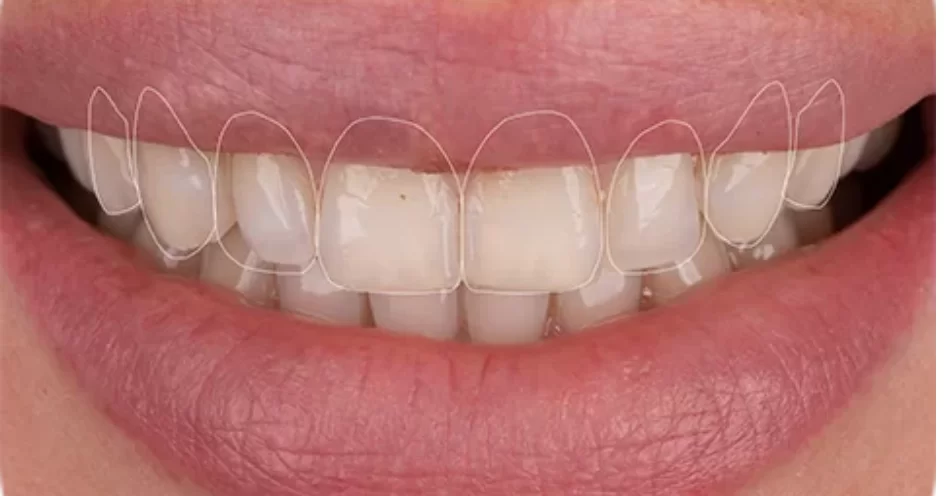
The process begins with a detailed data collection phase. Using high-resolution cameras and video equipment, images of the patient are recorded while speaking, smiling, and at rest. Then, a 3D digital model of the teeth is obtained using intraoral scanners. This data is transferred to special DSD software. On the software, ideal tooth sizes and positions are drawn, using the line passing through the patient’s pupils, the midline of the face, and the curves of the lips as references. At Dentocare Kahramanmaraş clinic, this process is carried out interactively with the active participation of the patient.
The Place of DSD in Dental Aesthetics
The biggest risk in aesthetic dentistry is the difference in the patient’s and the dentist’s perception of “beauty.” DSD is a communication tool that eliminates this risk. Patients no longer have to imagine the result in the dentist’s mind; they can see the result on the screen and in their mouths (mock-up). The roadmap for all treatments such as porcelain veneers, zirconium crowns, gum aesthetics (pink aesthetics), and orthodontics is determined through this design. DSD is a revolution that consigns aesthetic failure to history.
Advantages of Digital Smile Design
The advantages this system offers to patients and physicians are countless:
- Predictability: The treatment outcome is no longer a surprise.
- Personalization: Designs tailored to the face instead of standard teeth.
- Communication: The patient and physician can communicate through the same visual language.
- Trust: The peace of mind created by the patient knowing what they are investing in.
- Speed and Accuracy: The digital measurements are flawless.
Differences Between Traditional Smile Design and DSD
In traditional methods, the physician would tell the technician, “Let’s do aesthetic teeth for this patient,” and largely leave the initiative to the technician’s skill. In DSD, however, control is entirely at the planning stage. Here are the key differences:
| Features | Traditional Method | Digital Smile Design (DSD) |
|---|---|---|
| Planning | Based on the physician’s experience and visual assessment | Based on facial analysis and mathematical proportions |
| Mock-up | Usually not done or is a rough draft | A realistic, testable prototype is produced |
| Patient Participation | Limited (After the result is finished) (sees) | High (Involved in the design process) |
| Margin of Error | High (Risk of disapproval exists) | Minimum (Approved design is produced) |
| Process | Uncertain and open to revisions | Clear and planned steps |
Planning Process in Digital Smile Design
Planning is the heart of DSD. At Kahramanmaraş Dentocare, this stage is not rushed. Based on the collected data, the millimeter dimensions of the teeth, gum levels (zenith points), and tooth axes are determined. If there is asymmetry in the gums, gingivectomy (gum reshaping) with laser is planned. If there are missing teeth, the implant location is determined according to this design. In other words, DSD organizes not only the shape of the tooth but also the entire oral rehabilitation.
Personalized Digital Smile Analysis
Every face is unique, and so should every smile. The principles of “Visagism” (Face and character analysis) come into play during the analysis phase. For someone with oval facial features, more rounded and softer tooth lines are preferred, while for someone with angular facial features, stronger and more angular tooth forms are used.It can be mentioned. Even the patient’s age, gender, and occupation are influential parameters in this analysis.
How is Face, Lip, and Tooth Harmony Evaluated?
In an ideal smile, the incisal edges of the upper teeth (incisal line) should be parallel to the curve of the lower lip (wet-dry line boundary). This is called the “Smile Arc.” DSD software digitally draws this arc and places the teeth on this line. In addition, how much of the gum is visible during a smile, the dark areas at the corners of the lips (buccal corridors), and the harmony of the midline of the teeth with the midline of the face are evaluated in millimeters.
Aesthetic Proportions in Digital Smile Design
The “Golden Ratio” (1.618), considered the formula for beauty in nature, is also valid in dental aesthetics. There are specific ratios between the width and height of the two front incisors, as well as between the visible widths of the front teeth relative to each other. Dentocare dentists apply these proportions to the patient’s teeth using digital rulers. This results in a pleasing, balanced, and aesthetically pleasing alignment.
Digital Smile Design and Pre-Treatment Simulation
This is the most fascinating part of DSD. The designed teeth are placed on the patient’s digital photograph. The patient can see “before and after” side-by-side on the screen. This simulation is a unique opportunity for the patient to clarify their expectations and give feedback to the dentist, such as “could this part be a little longer?” or “let’s soften the corners a bit more.”
Pre-Treatment Result Preview (Mock-up) with DSD
You don’t just see it on the screen; with the “Mock-up” application, you can feel your new teeth in your mouth. The designed tooth form is created as a model using 3D printers, and a temporary material (cold acrylic or composite) obtained from this model is applied to the patient’s teeth without any damage (no cutting). The patient looks in the mirror, speaks, smiles, and a video recording is taken. This “test drive” is the most critical stage, guaranteeing the success of the treatment.
Technologies Used in Digital Smile Design
Kahramanmaraş Dentocare provides services with its fully equipped digital infrastructure. Intraoral scanners (cameras replacing traditional impression trays), professional studio photography equipment, powerful graphics processing computers, and 3D printers are essential components of this process. This technological integration brings the margin of error close to zero.
Digital Smile Design in Frontal Tooth Aesthetics
Front teeth are the showcase of the face. Asymmetries, discolorations, or crowding here affect a person’s entire expression. With DSD, even the slightest axial curvature in the frontal region can be detected and corrected. The amount of tooth abrasion required (or none at all – Prepless) for Laminate Veneer applications is determined in advance thanks to digital design. This provides a minimally invasive (protective) approach.
Natural Look with Digital Smile Design
The goal is not artificial-looking, bright white teeth, but natural teeth that look like they belong to the person’s face. From thousands of natural tooth forms found in digital libraries, those most suitable to the patient’s anatomy are selected. Micro-textures on the tooth surface, light reflections, and color transitions are added to the design to avoid artificiality.
How Long Does Digital Smile Design Take?
The design process is quite fast. The records (photos and scans) taken at the first appointment take approximately 30-45 minutes. The doctor usually completes the preparation of the digital design and the production of the mock-up model within 2-3 days. At the second appointment, the patient tries on their new smile. After the design is approved, the actual treatment process (veneers, zirconium, etc.) begins, and this process can vary between 5-10 days depending on the procedure to be performed.
Is Digital Smile Design Painful?
Absolutely not. The DSD process (photo taking, scanning, design, and mock-up trial) is completely painless. No intervention, needles, or cutting are done on the teeth. Only data is collected and a trial is done with a temporary, plastic-like material. This is a very pleasant and exciting process for patients.
Who is Digital Smile Design Suitable For?
It is suitable for anyone who is dissatisfied with their smile, complaining about the color, shape, or alignment of their teeth. Individuals with a gummy smile, diastema, broken or worn teeth can achieve the ideal look with DSD. Regardless of gender or age, any adult individual with aesthetic expectations can benefit from this protocol.
Shorter Treatment Process with Digital Smile Design
The more accurate the planning, the faster the application. Thanks to DSD, the lab technician knows exactly what to do. Time is not wasted on uncertainties such as “Will it fit?”, “Will the shape look good?”. Trial sessions are reduced, and the need for revisions is eliminated. This, in turn, saves time for Dentocare patients.
Patient Participation in Digital Smile Design
GeIn traditional dentistry, the patient is a passive recipient, whereas in the DSD concept, they are a partner in the process. The patient becomes the designer of their own teeth. Under the guidance of the dentist, they can direct the design by saying, “I want slightly more dominant and longer teeth” or “I want a softer and younger expression.” This participation brings the satisfaction rate at the end of the treatment close to 100%.
Application Stages After Digital Smile Design
Once the design is approved, the stage of turning this digital plan into reality begins. Depending on the chosen material (Porcelain Veneer, E-max, Zirconium), minimal preparations are made on the teeth. Then, digital measurements are taken again and production is carried out. Since the design is produced exactly as it is, there are no surprises in the final fitting.
Planning Aesthetics and Function Together with DSD
Teeth that only look good but are not functional (biting, chewing, speaking) are unsuccessful. DSD software also simulates jaw movements. Designed teeth must allow for the correct pronunciation of letters during speech (phonation) and must not damage the jaw joint during chewing. At Dentocare, aesthetics and function are presented in perfect balance.
Tooth Color and Shape in Digital Smile Design
Color selection is based on skin tone, eye color, and makeup habits. The whitest color on the scale is not always the most natural or beautiful. Form reflects character. Triangular, oval, or square tooth shapes are chosen to suit the individual’s temperament. DSD combines these subjective choices with objective criteria.
The Permanence of Digital Smile Design
Digital design is a plan; permanence depends on the quality of the treatment applied. Restorations planned with DSD and produced with high-quality materials (Laminate, Zirconium) maintain their aesthetics for 15-20 years or more with good oral care. Correct planning reduces the risk of fracture and wear because it ensures a balanced distribution of biomechanical forces.
Post-Digital Smile Design Care Recommendations
It’s important to maintain your new smile after achieving it. Regular brushing, flossing, and check-ups with your dentist every 6 months are standard. If you have a teeth-grinding habit, using a night guard is recommended to protect the designed aesthetics. Avoiding cracking hard-shelled foods with your front teeth will extend the life of the restorations.
A More Confident Smile with Digital Smile Design (DSD)
Smiling is the most beautiful way to look at life positively. You don’t have to hide your smile because of aesthetic concerns about your teeth. As the Kahramanmaraş Dentocare family, we design your dream smile on the screen first, then bring it to life with Digital Smile Design technology. For a smile journey that is free from surprises, scientific, artistic, and completely personalized for you, the possibilities of the digital world are at your disposal. This investment in yourself will refresh not only your appearance but also your mood and self-confidence.