
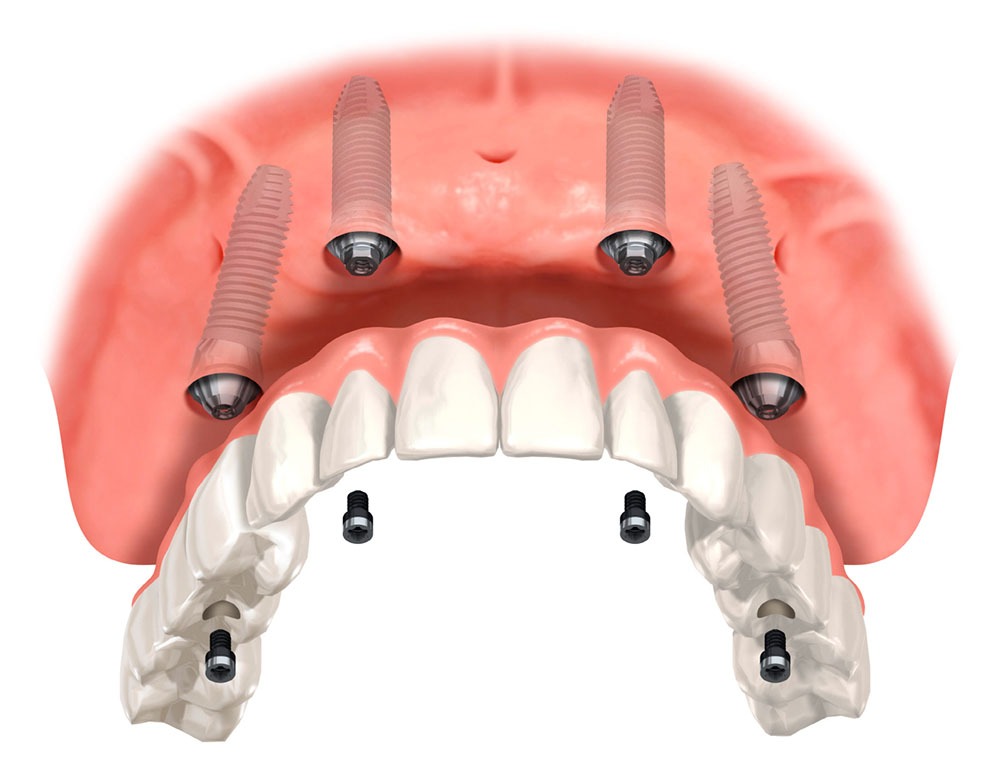
Full Jaw Implant Applications: Smile Again with Dentocare Kahramanmaraş
Oral and dental health is one of the most fundamental elements determining an individual’s quality of life. However, over the years, gum diseases, widespread cavities, or traumas resulting in the loss of all teeth (total edentulism) can cause devastating effects both physically and psychologically. Retention problems, sores, and speech difficulties experienced during the use of traditional full dentures (removable teeth) push patients towards more permanent and comfortable solutions. Dentocare, the leading implantology center in Kahramanmaraş, offers modern, fixed, and aesthetic solutions to the problem of edentulism with its “Full Jaw Implant Applications”. In these treatments, which utilize advanced surgical techniques such as All-on-4 and All-on-6, patients are freed from the difficulties of removable dentures and obtain fixed teeth that feel like their own natural teeth.
What are Full Jaw Implant Procedures?
Full jaw implant procedures are a process in which fixed porcelain or hybrid prostheses are placed on a certain number (usually 4, 6, or 8) of titanium implants strategically placed in the jawbone for patients who have lost all their teeth in the upper or lower jaw. This method is based on the principle of building a bridge on implants that provide load distribution according to biomechanical principles, instead of placing implants individually for each missing tooth. These systems, applied at Dentocare Kahramanmaraş clinic, are personalized according to the patient’s bone volume and anatomical structure, eliminating total edentulism and providing a fixed dental alignment.
Why is Full Jaw Tooth Loss Important?
The loss of all teeth is not just an aesthetic problem; it is a serious health problem that leads to the gradual resorption of the jawbone due to its inability to be stimulated. As bone resorption progresses, the facial profile collapses, the lips are drawn inward, and the nose and chin move closer together; this makes the person look much older than they are. Functionally, chewing capacity decreases by up to 20%, digestive problems begin, and speech articulation deteriorates. Full jaw implants break this negative cycle by preserving bone and supporting facial aesthetics.
The Purpose of Full Jaw Implant Treatment
The primary goal of the treatment is to free the patient from removable dentures known as “palate” and provide the comfort of fixed teeth. Unlike removable dentures, the palate portion is not closed in implant-supported fixed prostheses; this enhances the patient’s sense of taste and enjoyment of eating. At Dentocare, the goal is to enable the patient to smile in social settings without fear of their prosthesis coming off, to comfortably chew hard foods (apples, meat, etc.), and to regain their self-confidence.
Who is Suitable for Full Jaw Implant Applications?
It is suitable for patients whose general health condition is suitable for surgical procedure, whose bone development is complete, who are experiencing complete edentulism, or whose existing teeth are all indicated for extraction (cannot be saved). In patients with chronic conditions such as diabetes and hypertension, implants can be placed if the disease is under control. Even in patients with excessive bone loss, it is possible to create fixed teeth with angled implant placement (All-on-4 technique) or bone grafting procedures.
Why are Implants Preferred in Complete Jaw Tooth Loss?
Traditional full dentures only receive support from the gum tissue and lose their fit and become loose as the bone erodes over time. This leads to painful sores and insecurity. Implant-supported prostheses, on the other hand, receive support from the bone, are stable, and stop bone loss. Because it transmits chewing force to the bone like a natural tooth, chewing performance increases to 90-100%. This comfort and biological advantage make implant treatment indispensable.
Examination and Evaluation Before Full Jaw Implant Applications
At Kahramanmaraş Dentocare clinic, the process begins with very detailed planning. The physician evaluates the patient’s systemic diseases, medications, and expectations. During the oral examination, soft tissue thickness, tongue size, and opposing jaw relationship are assessed. However, the most critical stage is the 3D radiological examination. The volume of the jawbone, the location of nerve canals, and the degree of sinus sagging are determined.
The Effect of Bone Structure on Full Jaw Implants
Implant success depends on the quality and quantity of bone where the implant will be placed. In completely edentulous patients, bone loss and sinus sagging are common, especially in the posterior regions. Dentocare specialists measure bone density with 3D tomography (CBCT). If bone is insufficient, “Sinus Lifting” or bone graft procedures are performed to prepare the ground for implant placement. In some cases, angled implants can be placed in anterior regions where bone is available, allowing for fixed teeth without the need for further surgery.
Personalized Full Jaw Implant Planning
Each patient’s jaw arch, smile line, and facial type are considered.It is different. Therefore, the locations of the implants are determined not randomly, but with digital planning. The aesthetics of the teeth that will be placed on the implants are designed before surgery. This “Prosthetic-Focused Implantology” approach guarantees that the result will be both aesthetic and functional. Using surgical guides, implants are placed at the planned points with millimeter precision.
How are Full Jaw Implant Applications Performed?
The application process is carried out in sterile operating room conditions and under local anesthesia (or sedation):
- Preparation: If there are any teeth that need to be extracted, they are extracted, and the bone surface is smoothed.
- Implant Placement: Titanium implants are placed in the planned areas. In the all-on-4 technique, posterior implants are placed at a 30-45 degree angle, and anterior implants are placed straight.
- Impression and Temporary Teeth: If bone quality is suitable (sufficient primary stability is achieved), temporary fixed teeth can be screwed onto the implants on the same day (Immediate Loading).
- Healing: The implants are expected to fuse with the bone.
How Long Does Full Jaw Implant Treatment Take?
The procedure of placing implants in a single jaw takes an average of 2-3 hours. If temporary teeth are to be made on the same day, the patient’s stay in the clinic may be longer. The bone fusion period after surgery (osseointegration) is 2-3 months in the lower jaw and 3-4 months in the upper jaw. If bone graft material is used, this period can extend up to 6 months. The fabrication of permanent porcelain teeth after fusion takes 10-14 days.
Are Full Jaw Implant Procedures Painful?
Thanks to the strong local anesthetics or sedation applied during the procedure, the patient feels absolutely no pain. Even if many implants are placed, post-surgical pain and swelling are controlled with medications and ice application prescribed by the doctor. Our patients can usually return to their daily lives the next day. Dentocare meticulously applies the principles of “Painless Dentistry”.
Systems Used in Full Jaw Implant Treatments
Different concepts are applied depending on the degree of edentulism:
- All-on-4: This involves placing only 4 implants in the jaw and making a fixed prosthesis on top, avoiding the posterior regions where bone loss occurs. It is economical and fast.
- All-on-6 / All-on-8: This involves using 6 or 8 implants to increase load distribution in patients with sufficient bone volume. It provides greater biomechanical stability.
- Implant-Supported Removable Denture (Overdenture): These are dentures that are attached to 2 or 4 implants with a snap-on system, can be removed by the patient, but do not move in the mouth.
Full Jaw Implant Post-Treatment Recovery Process
Soft tissue healing occurs in the first week after the operation, and the stitches are removed. During this process, hot, spicy, and grainy foods should be avoided. Smoking is strictly prohibited as it increases the risk of implant loss. A soft diet is followed to prevent excessive load on the implants during the full healing and bone formation process.
Temporary Teeth Applications in Full Jaw Implant Treatment
No patient leaves our clinic without teeth. On the day the implants are placed, if the bone strength is sufficient, “Fixed Temporary Teeth” are fitted. If the bone is soft and implants cannot be loaded immediately, removable temporary prostheses that do not put pressure on the implants are prepared to ensure the patient’s aesthetics and speech. This allows the patient to spend the waiting period comfortably.
Traditional Palate vs. Full Jaw Implant
| Features | Full Jaw Implant (Fixed) | Traditional Full Palate |
|---|---|---|
| Comfort | Fixed, does not move. | Moves, may cause sores. |
| Chewing Power | High (Apples, meat can be eaten). | Low (Limited foods). |
| Taste Perception | Palate is open, taste is perceived. | Upper Palate It is closed. |
| Bone Protection | Protects the bone. | Bone resorption continues. |
Full Jaw Implant-Supported Fixed Prosthesis Options
Material selection is important in permanent prostheses:
* Metal Supported Porcelain: Durable and economical. * Zirconium Bridges: High aesthetics, tissue-friendly and lightweight. The closest appearance to natural teeth. * Hybrid Prostheses: Systems that use acrylic teeth on a metal or zirconium substructure, including gingival aesthetics, and are fixed with screws.
Aesthetic and Natural Appearance in Full Jaw Implant Treatment
In long-term edentulism, lip support is lost and the lips retract inwards. When designing implant-supported prostheses, the position of the teeth is adjusted to support the lips. In addition, artificial gum tissue (pink aesthetics) is used to mask the resorbed bone tissue and provide a natural gum appearance.Dentocare offers smile designs that create a “rejuvenation” effect for its patients.
Upper Jaw Full Implant Applications
Since the bone in the upper jaw is softer, at least 4, ideally 6 implants are usually preferred. If sinus cavities pose an obstacle, sinus lifting or angled implants (Pterygoid or Zygoma implants) are used. Having an open palate in upper jaw prostheses maximizes patient comfort.
Lower Jaw Full Implant Applications
The lower jaw bone is harder and of higher quality. Fixed prostheses can usually be made on 4 implants. Using removable prostheses in the lower jaw is very difficult (due to tongue movement); therefore, implant treatment is a lifesaver for patients with lower jaw edentulism.
Regaining Chewing Function with Full Jaw Implant Treatment
With fixed implant prostheses, the patient regains 90% of the chewing power they lost. Biting, tearing, and grinding functions occur with natural tooth sensitivity. This increases the patient’s dietary diversity, soothes the digestive system, and positively affects overall health.
Speech Comfort After Full Jaw Implants
Edentulism or a loose palate impairs the pronunciation of sounds like “s, sh, f, v” and causes hissing sounds. Fixed teeth on implants ensure the correct positioning of the tongue and correct phonetics. The patient can speak confidently and clearly without worrying about their teeth falling out of their mouth.
Things to Consider After Full Jaw Implant Procedures
Implants require lifelong care. The idea that “implants don’t decay, there’s no need to brush” is wrong. Oral hygiene must be maintained at a high level to prevent the development of gum disease (peri-implantitis) around the implant. If there is a teeth grinding habit, the use of a night guard is recommended.
Durability and Longevity of Full Jaw Implant Treatment
Scientific studies show that the 10-year success rate of full jaw implant treatments is 95-98%. With good care and regular check-ups, implants can last a lifetime. Prosthetic parts (porcelain) may wear down or require maintenance over the years, but implants within the bone are permanent.
Success Rate in Full Jaw Implant Treatment
Success depends on the correct surgical technique, a quality implant brand, sterilization, and patient care. Kahramanmaraş Dentocare minimizes the risk of complications with its expert staff and technological infrastructure. The success rate is close to perfect in patients who do not smoke and pay attention to oral care.
Care and Hygiene in Full Jaw Implant Treatment
To clean under fixed implant bridges, “Superfloss” dental floss, interdental brushes, and most importantly, an “Oral Irrigator” (Waterpik) should be used. An oral irrigator cleans food particles under the bridge with pressurized water and massages the gums. A check-up with a dentist and professional cleaning every 6 months is essential.
A Healthy, Functional and Aesthetic Smile with Full Jaw Implant Applications
Complete edentulism is not the end of life, but a harbinger of a new and comfortable beginning. As Dentocare in Kahramanmaraş, we restore not only your teeth but also your joy of life with full jaw implant applications. Break free from the bondage of dentures and experience the freedom of fixed teeth.