
Differences Between Apical Resection and Root Canal Treatment
The most fundamental mission of dentistry is to maximize the lifespan of natural teeth in the mouth and prevent tooth loss. Because no artificial prosthesis or implant can completely replace a person’s own natural tooth in terms of biological compatibility and functionality. In line with this mission, two basic procedures have been developed to save teeth at risk of being lost due to deep decay, trauma, or infections: “Root Canal Treatment” (Endodontic Treatment) and “Apical Resection” (Root Tip Surgery). Although both procedures aim to prevent tooth extraction, they are completely different in terms of application techniques, anatomical areas intervened, indications, and healing processes. These two treatments, which are often confused by patients or thought to be alternatives to each other, are actually complementary protocols that come into play in different pathological situations.
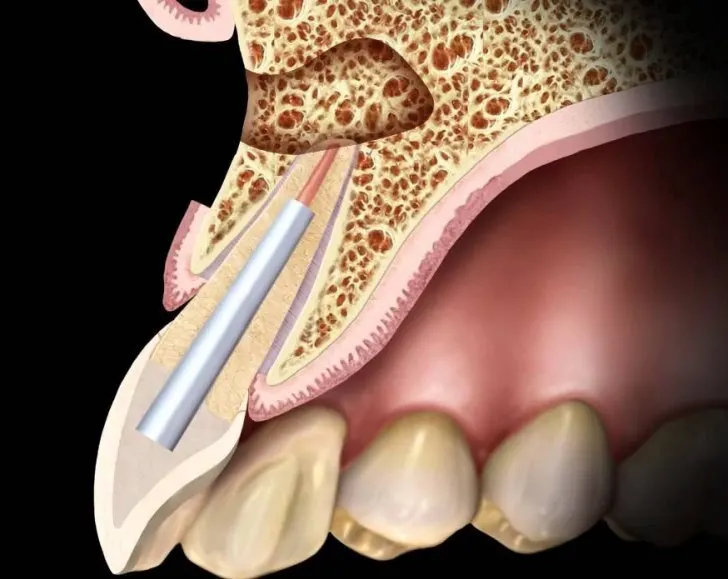
To understand the differences, it is first necessary to understand the anatomical structure of the tooth and the way the infection spreads. A tooth is not just the white part visible in the mouth (crown); it has roots embedded in the jawbone and canals extending within these roots, containing the blood vessels and nerve bundle. Root canal treatment is a cleaning procedure performed when the infection is in this canal space “inside” the tooth. Apical resection, on the other hand, is an “external” surgical intervention performed when the infection or pathology has spread from inside the tooth to the bone tissue at the tip of the root, forming a cyst or granuloma, and cannot be reached with root canal treatment. One cleans “from the inside,” while the other cuts and removes the problematic area “from the outside.” This fundamental distinction is the main factor determining the entire course of treatments and patient experience.
1. Root Canal Treatment: Controlling Infection from the Inside
Root canal treatment (Endodontics) is the first-line treatment applied when the pulp (nerves and blood vessels), the living tissue in the center of the tooth, becomes infected due to decay or trauma. In this procedure, no surgical incision is made, the gum is not lifted, and the bone tissue is not interfered with. The treatment is performed entirely through a small hole made in the chewing surface of the tooth. Using special files, the dentist removes the inflamed tissue inside the root canals, widens the canals, disinfects them, and fills them with a sealing material (gutta-percha).
The basic philosophy of root canal treatment is to sterilize the inner space where bacteria reside, thereby activating the body’s healing mechanism. Root canal treatment preserves the root structure and external anatomy of the tooth; only the “soft tissue” inside is removed. This procedure is usually performed under local anesthesia, and the patient can return to their daily life immediately after the procedure. The success rate is quite high and is often sufficient on its own to save the tooth.
2. Apical Resection: Surgical Intervention and Root Tip Cutting
Apical resection (apicectomy) is a “surgical” procedure that comes into play when root canal treatment is insufficient or cannot be performed due to anatomical obstacles. This procedure is not a filling or root canal cleaning, but a true “microsurgical” operation. In apical resection, the target is not the inside of the tooth, but the “apex,” the point where the root ends, and the surrounding jawbone. When pathological formations such as cysts, abscesses, or granulomas occur at the tip of the tooth root and these formations do not heal with root canal treatment, the surgeon lifts the gum, creates an opening in the bone, and directly accesses the problematic area.
In this procedure, not only is the infected tissue cleaned; a piece of approximately 3 millimeters from the tip of the tooth root, which has become a breeding ground for infection, is physically cut and removed (resected). Then, the end of the root canal is sealed retrogradely to prevent bacteria from re-emerging. Therefore, unlike root canal treatment, apical resection is an invasive procedure that shortens the length of the tooth, involves the bone and gum, and requires sutures.
Differences in Indications: Which Treatment is Applied When?
The most significant difference between the two treatments is the “timing of application” and the “necessity.” Root canal treatment is the primary treatment applied in cases of toothache or infection. Apical resection is generally referred to as a “secondary” or “rescue” treatment. Apical resection is not performed directly on a tooth; root canal treatment must have been performed or attempted first.
Root canal treatment is performed in the following situations:
- When deep caries has reached the nerve.
- In cases where nerves have died (necrosis) due to dental trauma.
- In cases of severe night pain and hot-cold sensitivity.
Apical resection is performed in the following situations:
-
- When an infection or cyst at the root tip has not healed despite root canal treatment.
- When root canal instruments cannot reach the root tip due to excessive curvature (dilaceration) or blockage (calcification) at the root tip.
rda.
- In cases where an instrument breaks during root canal treatment and cannot be removed.
- In cases where there is a crown or porcelain veneer on the tooth and removing this crown is risky (when access to root canal treatment is not possible).
Differences in Healing Process and Patient Experience
From the patient’s perspective, the biggest difference between the two procedures is the “healing process”. After root canal treatment, the patient may experience mild chewing sensitivity for a few days, but there is no swelling, bruising, or need for suture removal. The patient can speak as soon as they leave the treatment and can eat once the effects of the anesthesia wear off.
Apical resection, on the other hand, is a surgical procedure, so the post-operative process is more pronounced. Because the gum is cut and the bone is manipulated, mild swelling (edema) and rarely bruising may be seen in the face within the first 24-48 hours after the procedure. The patient has stitches, which need to be removed in about a week. Additionally, after an apical resection, the patient should apply ice compresses, eat soft foods, and pay extra attention to oral hygiene. While healing occurs quickly with root canal treatment, with an apical resection, soft tissue healing can take 1-2 weeks, and complete bone refill can take 6-12 months.
Comparison Table of Key Differences
The following table summarizes the technical and clinical differences between Root Canal Treatment and Apical Resection:
SuturesNot required.Required (Gum is closed with sutures).
| Features | Root Canal Treatment (Endodontics) | Apical Resection (Surgery) |
|---|---|---|
| Access Route | By drilling a hole in the top of the tooth (crown). | By making an incision in the gum and opening the bone. |
| Area of Intervention | Inside the root canals (Cavity). | Root tip (Outer surface) and surrounding bone tissue. |
| Surgical Nature | Not surgical (Conservative). | Micro-surgical procedure (Invasive). |
| Tooth Length | Unchanged, root integrity is preserved. | Because the root tip is cut, the tooth root is shortened by 3mm. |
| Order of Application | First procedure to be applied in case of infection It is a treatment. | It is applied if root canal treatment fails. |
Conclusion
In conclusion; root canal treatment and apical resection are two separate treatment methods that serve the same purpose (saving the tooth) but follow different paths. Root canal treatment is a more conservative and first-line treatment that tries to solve the problem “from the inside”. Apical resection, on the other hand, is a more advanced surgical procedure that attempts to solve the problem “from the outside” and from the root (literally, from the root tip). Both treatments are powerful weapons offered by modern dentistry to prevent tooth loss. Your dentist or endodontist will decide which treatment is appropriate for your tooth based on radiological examinations and clinical examination results. Every effort made to keep your own tooth in your mouth is the most valuable investment for your long-term oral health.







