
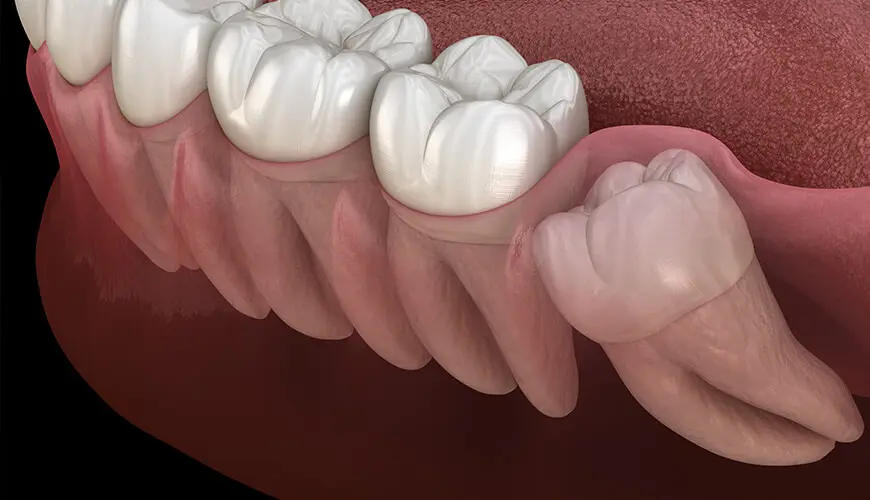
Why Do Wisdom Teeth Become Impacted?
Have you ever felt that familiar ache appearing in the very back corner of your jaw toward the end of adolescence or in the early years of adulthood? Known in dental terminology as the “third molars” and commonly referred to as “wisdom teeth” or “third molars,” these teeth are among the most problematic structures in the oral anatomy of modern humans. For many individuals, the eruption process of these teeth turns into a painful, uncomfortable journey that ultimately ends with a surgical intervention. But why? Why does our body continue to produce a tooth that often seems unnecessary and, most of the time, simply doesn’t fit?
An Evolutionary Perspective: Why Are Our Jaws Getting Smaller?
To understand why wisdom teeth become impacted, we need to look deep into history and examine the lifestyle of our ancestors. Thousands of years ago, human dietary habits were very different from today. Our ancestors consumed extremely hard and difficult-to-chew foods such as raw meat, tough roots, nuts with shells, and fibrous plants. To grind this demanding diet, they needed large, powerful jaws and a chewing system in which all 32 teeth were actively used. At that time, the third molars (wisdom teeth) were a vital part of the digestive process and usually had plenty of space in the jaw.
However, there is an interesting paradox: while our jaws have become smaller, the number and size of our teeth have not decreased at the same rate. Our genetic code still instructs our body to produce 32 teeth, but our anatomy now only has the capacity to comfortably accommodate 28 teeth. This “lack of space” (crowding) is the number one reason why wisdom teeth become impacted.
Anatomical Barriers and Eruption Path Issues
Wisdom teeth are the last teeth to erupt in the mouth. They usually attempt to emerge between the ages of 17 and 25. However, by the time they make their appearance, all the “seats” in the mouth have already been taken. Since the placement of the front teeth (the first and second molars) has already been completed, wisdom teeth struggle to find an eruption path. As a result, the tooth can become trapped beneath the bone or soft tissue.
The main factors that influence impaction include:
- Inherited Jaw Structure: When a person inherits a small jaw structure from one parent and large tooth size from the other, the teeth simply do not fit into the jawbone.
- Bone Density: As adulthood approaches, the jawbone becomes denser and loses its flexibility, making it more difficult for the tooth to break through the bone and emerge.
- Tooth Position (Angulation): The wisdom tooth bud may be positioned at an incorrect angle during its development. Instead of erupting vertically, the tooth may be horizontal, tilted forward, or tilted backward.
- Early Tooth Loss: Premature loss of primary teeth or shifting of permanent teeth can reduce the available space at the back of the jaw.
Classification of Impacted Teeth
Not all impacted teeth are the same. Dentists create a treatment plan based on the position of the impacted tooth. The angle of the tooth determines the difficulty of extraction and the potential damage it may cause to surrounding tissues.
1. Mesioangular (Forward-Tilted) Impacted Tooth
This is the most common type. The wisdom tooth is leaning toward the second molar in front of it. This can place pressure on the adjacent tooth, leading to decay or root resorption.
2. Distoangular (Backward-Tilted) Impacted Tooth
The tooth is tilted toward the back of the jaw (ramus area). Its removal usually requires greater technical precision.
3. Horizontal Impacted Tooth
The tooth lies completely horizontally within the jawbone. It exerts direct pressure on the roots of the adjacent tooth and is typically classified as “fully impacted” (bone-retained).
4. Vertical Impacted Tooth
The tooth is positioned at the correct angle, but there is insufficient bone space for eruption, or the bone is too thick.
Table: Types of Impacted Teeth and Possible Symptoms
The table below summarizes the symptoms and clinical presentation that may be observed depending on the type of impaction.
| Type of Impaction | Clinical Situation | Common Symptoms |
|---|---|---|
| Fully Impacted (Bone-Retained) | The tooth is completely covered by bone and gum tissue. It is not visible in the mouth. | Usually asymptomatic, but may predispose to cyst formation. Detected on X-rays. |
| Partially Impacted (Soft Tissue-Retained) | Part of the tooth is visible in the mouth, while the rest remains under the gum. | Food impaction, gum inflammation (pericoronitis), bad breath, difficulty opening the mouth. |
| Malpositioned Eruption | The tooth has erupted but is rotated toward the cheek or tongue. | Cheek biting, tongue irritation, decay due to inadequate cleaning. |
“The Silent Threat”: Can It Be a Problem Even Without Pain?
Patients often ask, “I don’t have any pain—why should I have it removed?” However, impacted teeth do not always send pain signals. In particular, the follicle (protective sac) surrounding fully impacted teeth can gradually fill with fluid and turn into cystic structures. These cysts can grow silently, causing bone loss in the jaw, damage to the roots of adjacent teeth, and, in very rare cases, tumoral formations.
In addition, the gum pocket (operculum) around partially impacted teeth creates an ideal hiding place for food debris. Bacteria can proliferate in this area, which is unreachable by brushing, leading to a painful inflammatory condition known as “pericoronitis.” If left untreated, this infection can cause difficulty swallowing and swelling of the lymph nodes in the neck.
Conclusion and Professional Evaluation
The impaction of wisdom teeth is an anatomical reality of modern humans. Not every impacted tooth needs to be extracted; however, every impacted tooth must be monitored. Panoramic X-rays or 3D tomography should be used to evaluate the tooth’s proximity to the nerve canal, its position, and the presence of any cysts.
If you experience pressure in the back of your jaw, recurrent gum swelling, or unexplained pain, this may be a sign of an impacted wisdom tooth. Early diagnosis is crucial for protecting adjacent teeth and managing potential cyst or infection risks. A detailed examination by oral and maxillofacial surgery specialists will clarify whether these “wisdom” teeth are a source of wisdom—or a source of trouble—for you.







