
When Should Impacted Wisdom Tooth Pain Be Taken Seriously?
A throbbing pain that starts in the back corner of the jaw and spreads to the ear, neck, and even temples… This condition, experienced by most adults at some point in their lives, is often dismissed as simple “teething pain.” However, wisdom teeth have a much more complex structure than other teeth in the mouth due to their anatomical location and eruption timing. The pain can sometimes be just a sign that the tooth is trying to erupt, but sometimes it can be an alarm bell for a serious infection, a cystic formation, or a pathology spreading to surrounding tissues.
The Source of the Pain: Why Do We Feel Pain?
To correctly interpret wisdom tooth pain, it is necessary to understand the source of the pain. Impacted teeth usually cannot fully erupt because they do not find enough space in the jawbone. This situation triggers two main pain mechanisms:
First, pressure pain. The impacted tooth exerts a pushing force towards the roots or crown of the second molar in front of it in order to find a way out. This mechanical pressure causes tension in the jawbone and referred pain (such as earache).
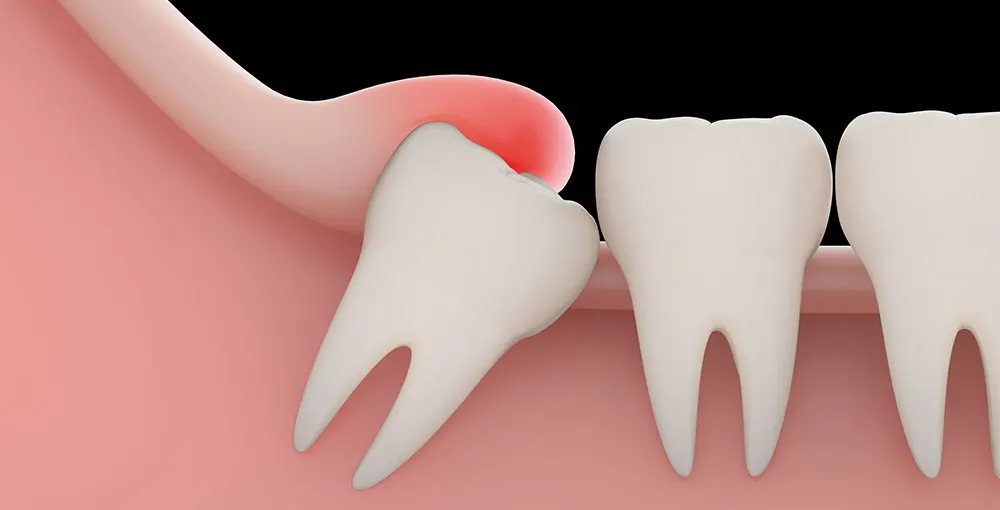
Second, and more dangerous, is infectious pain. “Pockets” form between the tooth and the gum tissue (operculum) covering the partially impacted tooth. These pockets are an ideal environment for the accumulation of food particles and bacteria. Infection developing in this area, which brushing cannot reach, is the most common cause of severe pain.
Red Flags: When Should You See a Doctor?
Not every pain requires immediate intervention; however, some symptoms indicate that your body cannot cope with the infection and the condition has become systemic. If you experience one or more of the following symptoms, you should consult a dentist or oral surgeon immediately:
If you have difficulty opening your mouth, if you have spasms in your jaw muscles, or if your mouth opening is less than two fingers wide, this is the clearest indication that the infection has spread to the chewing muscles (masseter or pterygoid spaces).
2. Swelling and Lymphadenopathy Spreading to the Neck
If the swelling is not limited to the gums but extends beyond the cheek, blurs the jawline, or if the lymph nodes in the neck (lymphadenopathy) become swollen and palpable, this indicates that the infection has progressed to deeper tissues.
3. Difficulty Swallowing (Dysphagia)
Difficulty swallowing due to pain or swelling indicates a risk of infection progressing to the throat (pharyngeal cavities), a serious condition that can threaten the respiratory tract. 4. Systemic Fever and Weakness
A body temperature above 38 degrees Celsius, chills, weakness, and general malaise indicate that the problem has progressed from a localized toothache to a systemic infection affecting the entire body. Table: Normal Toothache vs. Infection (Pericoronitis)
The most common dilemma for patients is distinguishing whether the pain is normal or pathological. The following table summarizes the key differences to help you make this distinction.
| Symptom | Normal Eruption Disorder | Serious Infection (Pericoronitis/Abscess) |
|---|---|---|
| Pain Character | Mild, aching, intermittent. | Severe, throbbing, constant, and awakens from sleep. |
| Swelling | Slight swelling only in the area where the tooth erupts. | Swelling that creates asymmetry in the cheek and is visible from the outside. |
| Mouth Odor | None or very mild. | Severe, metallic, or decay-like foul odor and taste. |
| Mouth Opening | Normal or very slightly restricted. | Severe restriction (Trismus), severe pain when opening the mouth. |
| Response to Pain Relief | Can be controlled with simple analgesics. | Pain relievers have a short-term effect or no effect at all. |
An Overlooked Risk: Loss of an Adjacent Tooth
Pain is not always caused by infection. A fully impacted and horizontally positioned wisdom tooth can silently progress over the years, eroding the root of the healthy second molar in front of it (root resorption). This process usually begins painlessly but develops into a deep ache in the later stages. Unfortunately, when a dentist is consulted at this stage, sometimes both the wisdom tooth and the damaged healthy tooth in front may need to be extracted. Therefore, it is critically important not to neglect routine checkups by saying “I have no pain” and not to wait for pain to begin.
Diagnosis and Management Process
When you encounter pain that needs to be taken seriously, the process works as follows:
- Clinical Examination: The dentist will examine the oral tissues,It assesses the size of the swelling and the mouth opening.
- Radiological Imaging: Panoramic X-ray is standard. In some cases, 3D dental tomography (CBCT) is requested to see the proximity of the tooth to the nerve canal (mandibular canal).
- Acute Phase Treatment: If there is an active infection and trismus (locking), the tooth is not extracted immediately. First, the goal is to suppress the infection with antibiotic treatment and mouthwashes, making the acute condition “chronic”.
- Surgical Intervention: After the infection is controlled, the tooth is removed with a planned surgical procedure.
Conclusion
Pain from an impacted wisdom tooth is the body’s way of saying “there is a problem here”. Especially in cases that do not respond to painkillers, are accompanied by swelling and fever, and make it difficult to open the mouth, it is vital to seek professional help as soon as possible instead of trying to solve the problem at home. Early intervention prevents the spread of infection and also makes the surgical procedure more comfortable.







