
What Is Filling Treatment in Children, and When Is It Necessary?
Childhood is a sensitive period in which physical growth is at its fastest, habits are formed, and the foundations of the body are established. One of the most important components of this process is oral and dental health. Primary (baby) teeth are often neglected with the thought that “they will fall out anyway and be replaced by new ones.” However, this approach carries major risks in terms of modern dentistry principles and the child’s overall health. Baby teeth do not only serve for chewing; they also directly affect speech, aesthetic appearance, jaw development, and most importantly, the health of the permanent teeth developing underneath.
Dental caries are one of the most common chronic diseases of childhood. Untreated cavities can lead to pain, infection, early tooth loss, and nutritional problems. At this point, “Filling Treatment”, one of the most fundamental practices of preventive and restorative dentistry, comes into play. So, is filling treatment in children different from that in adults? In which cases is a filling mandatory? What is the concept of a “colored filling”?
The Importance of Primary Teeth: Why Should They Be Treated?
Before going into the details of filling treatment, it is necessary to clearly answer the question, “Can baby teeth be filled?” Yes, baby teeth have living tissues (vascular and nerve bundles) just like permanent teeth. When decay occurs, these teeth can also cause pain, become inflamed, and develop abscesses.
There are three main reasons for treating baby teeth:
- Space Maintainer Function: Baby teeth act as natural guides for the permanent teeth developing underneath. If a baby tooth is lost early due to decay, the adjacent teeth may drift into the empty space, closing the path for the permanent tooth to erupt. This can lead to costly and long-term orthodontic treatments (braces) in the future.
- Risk of Infection: Untreated deep cavities can cause infection at the root tip, potentially damaging the enamel of the permanent tooth underneath (Turner Hypoplasia). They may also affect systemic health and carry the potential to cause problems in the heart, kidneys, and joints.
- Nutrition and Development: A child who cannot chew properly due to tooth pain may swallow food without chewing or avoid eating altogether. This negatively affects growth and development.
What Is Filling Treatment in Children?
Filling treatment in children (Restorative Treatment) is the process of restoring the function and aesthetics of a baby tooth or a young permanent tooth that has lost structure due to decay, fracture, or structural defects by repairing it with biocompatible materials.
The difference from adult fillings lies in the selection of materials and techniques suitable for the child’s dental structure and psychology. The enamel of baby teeth is thinner, and the pulp chamber (where the nerves are located) is larger. Therefore, the filling materials used should both protect the tooth and be quick to apply.
Conditions Requiring Filling Treatment (Indications)
As a parent, you may not always be able to determine whether your child needs a filling by observation alone. However, the following conditions usually indicate the need for restorative intervention:
1. Dental Caries (Cavity Formation)
This is the most common reason. It involves the formation of black or brown spots and cavities on the tooth surface. When decay passes through the enamel and reaches the dentin layer, it must be cleaned and filled.
2. Tooth Fractures (Trauma)
Fractures in the front teeth caused by falls or impacts create aesthetic concerns and also lead to tooth sensitivity. These fractures can be repaired with aesthetic fillings (bonding).
3. Structural Defects (Hypoplasia)
In some children, enamel defects (stained or pitted surfaces) may occur as teeth erupt. Since these areas are highly prone to decay, they may need to be covered with protective fillings.
Types of Fillings Used in Children
Filling materials used in pediatric dentistry have different characteristics compared to those used in adults. The goal is not only to fill the cavity but also to protect the tooth against future decay.
| Type of Filling | Characteristics | Area of Use |
|---|---|---|
| Compomer Fillings | A mixture of composite and glass ionomer. Has fluoride-releasing properties. | The most commonly preferred material for baby teeth; allows for “colored fillings.” |
| Composite Fillings | Tooth-colored, aesthetic, and durable. Hardened with light. | Preferred for anterior baby teeth and permanent teeth. |
| Glass Ionomer Fillings | Chemically bonds to the tooth and releases high levels of fluoride. Highly tolerant to moisture. | Used in situations where isolation is difficult or as a temporary filling. |
| Stainless Steel Crowns (SSC) | Prefabricated metal crowns. Used when the tooth is too damaged for a filling to hold. | Posterior baby teeth that have undergone root canal treatment or have extensive structure loss. |
Colored Fillings: Turning Treatment into Fun
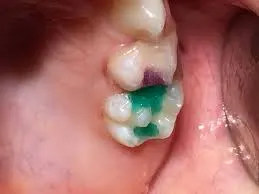
One of the most colorful innovations in pediatric dentistry is “compomer-based colored fillings.” Produced in vibrant colors such as pink, blue, green, orange, and purple, these fillings attract children’s attention with their glittery content. Allowing the child to choose their own filling color increases participation in treatment, reduces fear, and turns the procedure into a “game.” These materials are medically very safe and also protect the tooth against decay by releasing fluoride.
How Does the Treatment Process Work?
Filling treatment in children involves psychological management as much as technical precision. The process generally follows these steps:
- Introduction and Acclimatization: The dentist introduces the instruments using child-friendly language (e.g., “germ vacuum,” “water gun,” etc.). (Tell-Show-Do technique).
- Anesthesia (If Necessary): If the cavity is deep and there is a risk of pain during the procedure, local anesthesia is applied. Today, digital anesthesia methods have made this stage very comfortable. For superficial cavities, anesthesia may not be required.
- Removal of Decay: The decayed tissue is completely removed using special burs.
- Placement of the Filling: The selected filling material (colored or tooth-colored) is placed into the cavity and hardened with a special light device.
- Bite Adjustment: The child is asked to bite down, excess material is adjusted, and polishing (polishing) is performed.
Filling or Root Canal Treatment?
This is a topic that parents frequently confuse. If the decay is limited to the enamel and dentin layers, a filling is sufficient. However, if the decay progresses and reaches the tooth’s nerve (pulp), causes night pain, or results in spontaneous throbbing, a filling alone is not enough. In this case, “Root Canal Treatment” for the baby tooth or “Pulpotomy,” where part of the nerve is removed, should be applied. This decision is made by the dentist based on radiographic examination and clinical tests.
Points to Consider After Treatment
After the filling procedure, if anesthesia was applied, it is recommended that the child does not eat until the numbness wears off (approximately 2 hours), as they may unknowingly bite their lip or cheek. If no anesthesia was applied, they may eat immediately. Filled teeth can decay just like natural teeth; therefore, brushing and flossing should continue with the same level of care.
Prevention Is Easier Than Treatment: Fissure Sealants
This is the process of sealing the grooved surfaces of molars that have not yet developed cavities but are prone to decay with a flowable filling material called a “Fissure Sealant” (protective varnish). This procedure is applied without causing any damage to the tooth (without abrasion) and prevents food debris from adhering to the tooth surface. It is the most effective preventive method that blocks the path leading to fillings.
Conclusion
Filling treatment in children is not only about saving a tooth but also about protecting the child’s overall health, nutrition, and psychology. Without falling into the misconception of “it’s just a baby tooth, it will fall out,” detecting cavities at an early stage through regular dental check-ups and having them treated is one of the most important responsibilities of parents. Remember, healthy baby teeth are the foundation of a healthy adult oral structure.







