
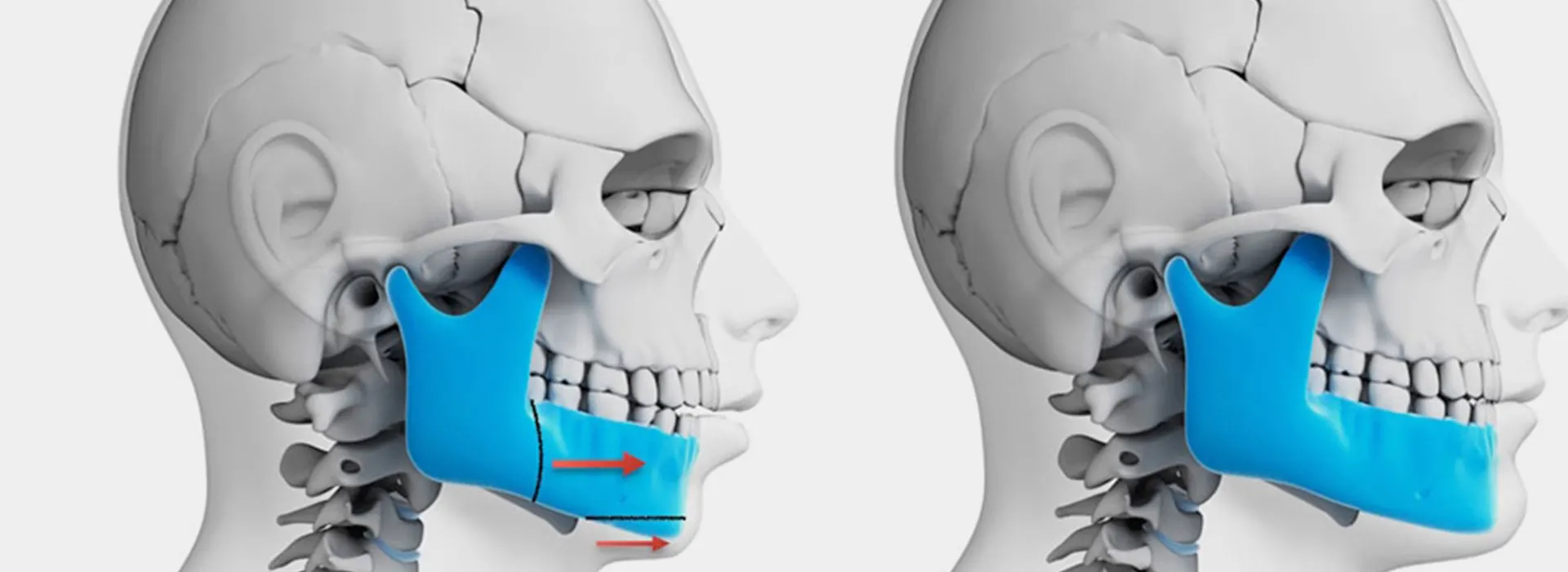
What Is Orthognathic Surgery in Kahramanmaraş?
The human face is an exceptionally complex anatomical whole where aesthetic proportions, golden-ratio geometry, and vital biomechanical functions converge. The core
skeletal foundation of this integrity is the three-dimensional relationship between the lower jaw (mandible) and upper jaw (maxilla) with the base of the skull.
During growth and development, this delicate harmony can be disrupted due to genetic factors, environmental influences, or childhood trauma. When one or both jaws grow
more than normal, lag behind, or develop asymmetrically, the condition is referred to in medical literature as “skeletal malocclusion.” These deep incompatibilities,
which originate from the bone structure rather than merely the alignment of teeth, are too significant to be resolved by conventional orthodontic braces alone.
At this point, orthognathic surgery in Kahramanmaraş comes into play as an advanced maxillofacial intervention that restores vital functions such as
chewing, breathing, and speech, while also delivering a remarkable aesthetic improvement in the patient’s facial profile. Also known as jaw surgery, this discipline
aims to correct skeletal abnormalities so that the teeth, the temporomandibular joint (TMJ), and facial muscles function in perfect harmony.
Although skeletal jaw disorders are often perceived by the public as merely an aesthetic concern or a desire to look better, the functional damage they create in the
body is far deeper. In individuals with a severely retruded lower jaw (retrognathia), the airway narrows, leading to severe sleep apnea and snoring problems. In
patients whose upper jaw is retruded or whose lower jaw is protruded (prognathia), the front teeth do not contact each other, so tearing and grinding functions are
almost completely lost; this can lay the groundwork for chronic digestive system disorders. Asymmetric loads placed on the jaw joint (TMJ) can, over the years, cause
wear of the joint cartilage and lead to severe head and neck pain. Dentocare Clinic approaches these complex anatomical problems in the Kahramanmaraş
region with a multidisciplinary perspective. The core vision of our clinic is to rebuild not only the alignment of the teeth, but also the patient’s breathing quality,
chewing biomechanics, and self-confidence in social life from the ground up. This treatment protocol—where orthodontists and maxillofacial surgeons work in synchronized
coordination under one roof—is a medical turning point that transforms a patient’s quality of life fundamentally and permanently.
Medical Boundaries Between Orthodontic Camouflage and Orthognathic Surgery
When diagnosing a skeletal problem, the clinician’s most critical decision mechanism is whether the issue can be addressed only by adjusting tooth inclinations
(camouflage) or whether it requires cutting and repositioning the bone itself (surgery). In adult individuals who have completed growth, the bone structure has already
hardened; therefore, attempting to correct severe jaw retrusion or protrusion solely with braces can produce dangerous outcomes, such as pushing teeth outside their
bony housing (root resorption and gum recession). Orthognathic surgery addresses the source of the problem (the basal bone) rather than working around it.
To analyze the effects, biomechanical limits, and long-term outcomes of these two different approaches more clearly in the patient’s clinical picture, reviewing the
comparative table below will enhance clinical awareness:
| Clinical Comparison Criterion | Orthognathic Surgery (Skeletal Correction) | Orthodontic Camouflage (Braces Only) |
|---|---|---|
| Tissue Targeted | The basal structure of the lower and/or upper jawbone (the entire bone framework). | Only the root inclinations of teeth within the alveolar housing. |
| Functional Benefit | Expands airway volume (resolves apnea) and permanently corrects chewing and joint dynamics. | Relatively improves tooth bite (occlusion) only; does not affect the skeletal airway. |
| Change in Facial Profile | Provides a dramatic, distinct, and lasting aesthetic improvement in facial profile aligned with the golden ratio. | Does not create a noticeable bony change in the facial profile (chin, nasal base, cheek fullness). |
| Target Patient Group | Adult patients (over 18) who have completed growth and have severe skeletal asymmetry. | Borderline cases where the skeletal discrepancy is very mild and the patient has no aesthetic concern. |
3D Digital Surgical Planning Protocol at Dentocare Clinic
The greatest revolution in modern maxillofacial surgery is advanced three-dimensional (3D) imaging and virtual planning systems that have replaced conventional
two-dimensional X-rays. Orthognathic surgery is an engineering masterpiece that requires precision to a tenth of a millimeter and allows no margin for error. At
Dentocare Clinic, the surgical process begins months before the operating room—within a virtual environment. A Cone Beam Computed Tomography (CBCT) scan is performed,
and the skull bones, airway, nerve canals, and tooth roots are transferred into the digital environment in a one-to-one manner. Using specialized surgical software,
the exact movement of the bones, the angle of jaw rotation, and the response of facial soft tissues (lips, cheeks, nasal tip) to this bony movement are simulated
down to the millimeter. Our patients have the privilege of seeing their post-operative facial profiles on 3D screens even before treatment begins. After virtual
planning, “3D surgical guide splints” (surgical splints) that ensure the jaws are fixed in the exact target position during surgery are custom-produced with 3D
printers.
This major clinical transformation is not a magical touch that happens in a single day; it consists of two main phases that require patience, discipline, and teamwork.
The process at Dentocare Clinic standards includes the following strategic steps:
- Pre-Surgical Orthodontic Preparation (Decompensation): Over the years, the body attempts to adapt to an incorrect jaw position by tipping the teeth
and creating an artificial bite (compensation). In this first phase—typically 12–18 months before surgery—the orthodontist uses braces or clear aligners to reverse
this tipping and bring the teeth back to their ideal angles on their respective jawbones (decompensation). During this stage, the asymmetry may temporarily become
more noticeable, because the teeth are being prepared to “lock” perfectly when the jaws are brought together during surgery. - Skeletal Repositioning (Surgical Phase): Once orthodontic preparation is complete, the maxillofacial surgeon takes over under general anesthesia.
Without leaving any external incision scars on the face, all procedures are performed intraorally: the jawbones are mobilized and permanently fixed in their new,
3D-planned positions using titanium mini plates and screws.
Post-Operative Recovery and Adaptation to a New Life
The first few weeks after orthognathic surgery are an adaptation period during which the body adjusts to the new skeletal structure and tissue swelling. Thanks to
evolving minimally invasive surgical techniques, traumatic practices of the past—such as “wiring the jaws together for months”—have been replaced by comfortable and
flexible elastic fixation. With the close follow-up and nutrition protocols provided by Dentocare Clinic physicians after surgery, patients quickly move beyond the
initial liquid and purée diet and transition gradually to normal chewing function. By the end of the first month after the operation, most facial swelling subsides,
and the striking, symmetrical, golden-ratio-aligned new facial profile begins to emerge clearly.
The impact of this physical change on an individual’s inner world is invaluable. Someone who has suffered for years from sleep apnea and waking up fatigued due to a
retruded lower jaw experiences high-quality sleep after surgery thanks to an expanded airway; as the amount of oxygen reaching the brain increases, life energy rises.
A patient who could not bite freely because the teeth did not contact, and who hid their smile in photos, re-enters social life with tremendous confidence—supported
by a symmetrical bite and an aesthetic jawline after surgery. Jaw surgery is not merely a bone-correction operation; it is a unique clinical journey in which an
individual makes peace with their reflection, breaks free from functional limitations, and rediscovers life with all its flavors. With the advanced technology
infrastructure of Kahramanmaraş Dentocare Clinic and an authoritative team of physicians, you too can leave jaw-facial asymmetries behind and step confidently into the
strong, aesthetic posture that comes with healthy anatomy.







