Can Baby Teeth Be Filled? The Most Frequently Asked Questions by Parents
The most frequently asked question by parents in dental clinics, especially in Pedodontics (Children’s Dentistry) departments, is filled with anxiety and uncertainty: “Doctor, this tooth will fall out anyway and a new one will come in its place, is there really a need for a filling?” While this question seems based on perfectly understandable logic, the answer is profound enough to affect not only the child’s oral health but also their overall growth and development.
The common perception in society that “Baby teeth are temporary and don’t need to be treated” has completely changed with the modern approach to dentistry. Baby teeth are not only temporary organs used for chewing; they are biological guides that protect speech, jaw development, aesthetic appearance, and most importantly, the health and position of the permanent teeth that will come from below.
The Basic Question: Why Are Fillings Done in Baby Teeth?
Baby teeth are structurally different from permanent teeth. Their enamel is thinner, their dentin tubules are wider, and the nerve-vascular bundle we call “pulp” is closer to the tooth surface. These anatomical features cause baby teeth to decay much faster than permanent teeth, and the decay can progress very quickly and reach the nerve.
The main purposes of filling baby teeth are:
- To Relieve Pain and Protect Nutrition: A decayed tooth causes pain. A child in pain cannot eat, chew, and swallows food whole. This can lead to nutritional deficiencies and digestive problems in a growing child.
- To Prevent Infection: Untreated cavities can cause infection (abscess) at the root tip. This infection threatens both the child’s overall health (heart, kidneys, joints) and can damage the enamel of the developing permanent tooth underneath (Turner Hypoplasia).
- Function of a Space Maintainer: The most important function of a baby tooth is to guide the permanent tooth underneath. If a baby tooth is extracted prematurely due to decay, the adjacent teeth shift into the space, closing the area where the permanent tooth will erupt. This situation leads to costly and long-term orthodontic (braces) treatments in the future.
Frequently Asked Questions from Parents (FAQ)
Below are the most common questions we hear from parents in clinical practice and their medical answers:
1. “It’s going to fall out anyway, can’t we just extract it?”
This is the most frequently asked question. In dentistry, the principle that “the child’s own tooth is the best space maintainer” applies. Extracting a baby tooth before its natural shedding time leads to the “space loss” problem mentioned above. If the tooth can be saved with a filling or root canal treatment, the priority is always to keep the tooth in the mouth. Extraction is only a last resort for teeth that are too damaged to be treated.
2. “Will it hurt my child? Will anesthesia be used?”
Comfort is essential in pediatric dentistry. If the decay is very superficial, the procedure can be performed without anesthesia. However, in deep cavities, local anesthesia is applied to prevent pain during the procedure. Nowadays, children usually do not feel the injection because very fine needles or digital anesthesia methods are used specifically for children. Topical gels applied before the procedure also numb the gums and increase comfort.
3. “What are colored fillings? Are they harmful?”
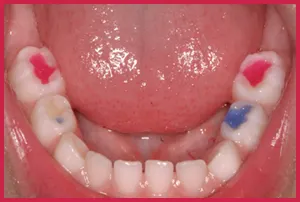
These are special fillings with a “compomer” structure, developed to increase children’s compliance with treatment. They can be in vibrant colors such as pink, blue, green, orange, and can even have glitter. These materials are medically safe and, by their very nature, even have the ability to protect the tooth from decay by releasing fluoride. Allowing the child to choose their own filling color turns the treatment into a game and increases their motivation.
4. “My child is very scared when getting a filling, what can we do?”
Pedodontists (Children’s Dentists) are specialists trained in child psychology. They introduce the instruments to the child using the “Tell-Show-Do” technique. In cases of excessively anxious, difficult-to-communicate, or very young children, the option of performing all procedures in one session under “Sedation” or “General Anesthesia” may be considered.
Difference Between Primary and Permanent Tooth Fillings
Fillings done on primary teeth show some differences from adult fillings in terms of material and technique. The following table summarizes these differences:
| Feature | Milk Tooth Filling | Adult Filling |
|---|---|---|
| Material Preference | Generally Compomer (Colored/Fluoride) or Glass Ionomer. | Generally Composite or Porcelain. |
| Application Time | It is applied quickly because the child’s patience is limited. | Longer for aesthetic details. It can last. |
| Purpose | To preserve function and keep it in the mouth until the age of shedding. | Long-lasting durability and aesthetics. |
| No Anesthesia Requiredneed | It is necessary for deep cavities, but may not be necessary for superficial ones. | It is necessary in most cases. |
What Happens If It Is Not Treated? A Scenario Analysis
In situations where parents are undecided, knowing the possible course of an untreated cavity makes decision-making easier:
- Beginning: A white/brown stain forms on the tooth. The child starts to feel pain when eating sweets. (Filling is very simple at this stage).
- Progression: The cavity goes deeper, pain occurs when eating. Food particles fill the cavity. (Filling is still possible).
- Reaching the Nerve: Severe pain that wakes the child from sleep at night begins. The cavity has reached the nerve. (Now “Root Canal Treatment” or “Amputation” is required).
- Infection: An abscess forms in the tooth root, the cheek swells. The child may develop a fever. (At this stage, the tooth may need to be extracted and a space maintainer becomes necessary).
Important Tip: Do Not Confuse with Fissure Sealant
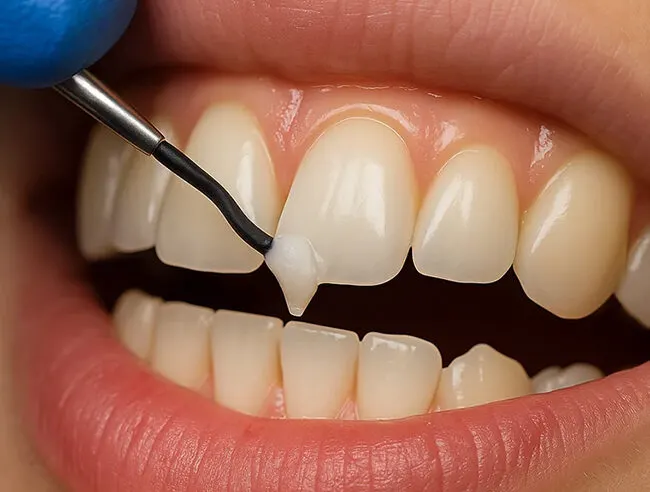
Sometimes parents confuse “Fissure Sealant,” a preventative procedure, with fillings. Fissure sealant is like a “nail polish” applied to the grooves of teeth that have not yet developed decay, preventing decay. A filling, on the other hand, is the cleaning of existing decay and filling the cavity. One is preventative (like a vaccine), the other is curative.
Conclusion
Filling baby teeth is a necessity of modern medicine and an investment in the child’s health. Every tooth neglected with the mindset of “it will fall out anyway” is a brick stolen from a child’s future oral health. For a child who is pain-free, eats healthily, and smiles with confidence, early detection and treatment of baby tooth decay using appropriate methods is of great importance. Regular dental check-ups ensure that this process is managed in the most cost-effective and comfortable way.