How Long Does a Dental Filling Take in Children?
The biggest concern parents have when bringing their children to the dentist is usually not the difficulty of the procedure, but rather the “time” involved. Children’s naturally active nature, short attention spans, and tendency to get bored quickly from sitting still can turn every minute in the dentist’s chair into a stressful wait for parents. Questions like, “How long will it take?”, “Can my child keep their mouth open for that long?”, “Will the procedure be interrupted?” are the most fundamental questions that occupy their minds before an appointment.
In pediatric dentistry (Pedodontics), time management is as critical a factor as the quality of treatment. Because when a child’s “tolerance limit” is exceeded, even the simplest procedure can become impossible. Therefore, pedodontists are trained to complete treatment with the precision of a “race car driver”; quickly, safely, and effectively.
“Invisible” Factors Determining the Duration
Saying that the “standard duration for a dental filling is 20 minutes” can be misleading. Because every child, every tooth, and every cavity is unique, like a fingerprint. The dynamics affecting the duration are:
1. Child’s Cooperation (Acceptance): This is the most decisive factor. While a child who cooperates with the dentist and keeps their mouth open as required may complete the procedure in 15 minutes, a child who constantly cries, moves, or closes their mouth may take up to 45 minutes. Sometimes the persuasion process takes longer than the procedure itself.
2. Depth and Location of the Cavity: While cleaning a superficial enamel cavity takes minutes, a deep cavity close to the nerve may require “Amputation” (partial root canal treatment), which prolongs the duration. Also, cavities in the most inaccessible areas of the back teeth require more treatment time than those in the front teeth.
3. Need for Anesthesia: If the decay is deep and local anesthesia (injection) is required, approximately 5-10 minutes are needed for the medication to take effect (numbness). Simple fillings done without anesthesia take much less time.
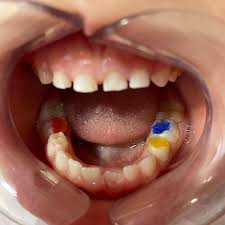
4. Material Used: “Compomer” (colored fillings) or ready-made “stainless steel crowns,” frequently used in primary teeth, are technically quick materials to apply. Aesthetic composites requiring layering techniques, used in adults, take more time.
Step-by-Step Process: How Many Minutes Does Each Stage Take?
A filling appointment should be considered not as a “single piece of time,” but as a whole set of stages. An average filling session proceeds as follows:
1. Preparation and Persuasion (Tell-Show-Do) – (5-10 Minutes)
Treatment does not begin immediately when the child sits in the chair. The dentist introduces the instruments (“Look, this is a water gun,” “This is a germ cleaner,” etc.). This stage is the most valuable time spent gaining the child’s trust and overcoming their fear. If this stage is successful, the rest of the treatment progresses very quickly.
2. Anesthesia (If Necessary) – (5-10 Minutes)
First, a topical gel is applied (1 min), then anesthesia is administered (1-2 min), and the tooth is allowed to become completely numb (5-7 min). During this waiting period, the child is usually talked to or shown cartoons.
3. Cleaning the Decay – (5-10 Minutes)
The dentist cleans the decayed tissue using rotary instruments or hand instruments. The larger the decay, the longer this time will be. It is very important for the child to remain still during this stage.
4. Placement and Hardening of Filler – (5-10 Minutes)
The filler material is placed in the cleaned cavity. In light-cured fillers (blue light), hardening occurs within seconds. However, shaping the filler, removing excess, and polishing takes time.
Average Time Table
The table below shows estimated times for a child with normal compliance (active time in the chair, excluding waiting room time):
| Type of Procedure | Anesthesia Status | Estimated Time |
|---|---|---|
| Simple Superficial Filling | None | 15 – 20 Minutes |
| Deep Filling (Bilateral) | Yes | 30 – 40 Minutes |
| Amputation + Filling | Yes | 40 – 50 Minutes |
| Front Tooth Aesthetic Filling (Fractured) | Yes/No | 30 – 45 Minutes |
Difference in Time Between Primary and Permanent Tooth Fillings
The treatment of primary and permanent teeth differs technically. The materials used in primary teeth are generally “bulk-fill” (can be filled in one go) and have a higher tolerance to moisture. This allows the procedure to be completed faster.
In permanent teeth, however, due to aesthetic concerns and the fact that the tooth will remain in the mouth for a lifetime, more delicate procedures requiring layering techniques and taking longer are applied. So, as a general rule; milk tooth fillings take less time than permanent tooth fillings.
In Multiple Caries ZTreatment Management: Sedation Option
If a child has 8-10 cavities in their mouth and needs to sit in the chair for 30-40 minutes for each, this can turn into a grueling marathon for both the child and the family. Children’s tolerance may decrease slightly with each session.
In cases requiring “multiple tooth treatments” or in very young (uncooperative) children, the option of Sedation or General Anesthesia can be considered to complete all procedures in one go. In a single 1-2 hour session under general anesthesia, all fillings, root canals, and extractions that would otherwise take months are completed. This is the most effective method for shortening the overall process.
Choosing the Right Appointment Time
The simplest way to shorten and make treatment efficient is to choose the right appointment time.
- Morning Hours: This is the time when children are most energetic, cooperative, and tolerant. Morning hours should be preferred for difficult and lengthy procedures (root canal treatment, deep fillings).
- Afternoon: For a tired and sleepy child after school or daycare, 20 minutes in the chair can feel like an hour. A tired child becomes restless more quickly, and the procedure time is extended.
The Role of the Parent: How Can You Speed Up the Process?
Shorter time doesn’t only depend on the doctor; parents can also contribute to this process:
Preparation: You can practice at home by playing games with your child such as, “You’ll have to open your mouth wide and not close it at all, let’s open it like a lion!”
Calmness: The parent’s tension is transferred to the child. If you remain calm, the child will feel safe and make the doctor’s job easier.
Not Interfering: Not interrupting while the dentist is communicating with the child prevents confusion of commands. When the child focuses on a single sound, the procedure progresses faster.
Important Tip: First Appointment Rule
If it’s your child’s first dental experience or if they are very scared, usually no procedure is done or only a simple examination is performed in the first session. This “Introductory Session” is 15-20 minutes spent building trust. This time is the biggest investment that ensures fillings in subsequent sessions go much faster and smoother.
Conclusion
The duration of dental fillings in children is a combination of many biological and psychological factors. This procedure, which takes an average of 20-40 minutes, is very valuable time spent to ensure your child has a healthy mouth for life. Your pediatric dentist will determine the most appropriate timing and method based on your child’s temperament and the condition of the tooth. As a parent, your task is to choose the right timing, be patient, and prepare your child for this process with a positive approach. Remember, that half hour in the chair will save your child from days of toothache.