Mandibular Retrusion Surgery in Kahramanmaraş
In human anatomy, the lower jaw (mandible) is far more than a mobile bone responsible for speech and chewing; it is a fundamental structural element that determines
the aesthetic balance of the facial profile and the width of the airways. When, during growth and development, the mandible does not grow sufficiently in relation to
the upper jaw and the cranial base and remains smaller and positioned farther back than normal, this condition is referred to in medical literature as “Retrognathia”
(mandibular retrusion). From the outside, it is characterized by the chin being positioned very close to the neck, difficulty closing the lips, and a convex profile.
While this condition profoundly affects physical appearance, an analysis of the clinical presentations of patients seeking
mandibular retrusion surgery in Kahramanmaraş clearly shows that the primary problem lies beneath the surface—within the body’s vital functions.
Mandibular retrusion is not merely an aesthetic concern felt when looking in the mirror; it is a complex skeletal syndrome that reduces cellular oxygenation,
disrupts sleep quality, and damages the cervical spine.
In individuals with a skeletally retruded mandible, the base of the tongue and surrounding soft tissues are also forced anatomically backward, toward the throat
space. This causes narrowing of the upper airway near the top of the trachea. During daytime hours, muscle tone can partially compensate for this narrowing; however,
when muscles relax during sleep, the airway may become completely obstructed, leading to severe snoring and episodes of breathing توقف (apnea) during sleep known as
“Obstructive Sleep Apnea” (OSA). Insufficient oxygen supply to the brain can cause the individual to wake up with chronic fatigue, experience concentration problems
during the day, and, over the long term, become predisposed to cardiovascular diseases. Dentocare Clinic addresses this multidimensional clinical
picture in the Kahramanmaraş region using advanced maxillofacial surgical techniques, repositioning the mandible into its correct location in three-dimensional space.
In this way, not only are the facial golden proportions reconstructed, but the patient’s narrowed airway is also opened—providing a vital functional rescue.
Biomechanical Analysis of Retrognathia (Mandibular Retrusion)
Skeletal mandibular retrusion is not a superficial alignment issue that can be overcome with simple braces alone. Insufficient bone volume makes proper tooth contact
(occlusion) impossible. Individuals with a retruded mandible often cannot tear food with their front teeth and cannot grind effectively with their back molars. This
chewing insufficiency increases the load on the stomach and intestinal system, opening the door to chronic digestive complaints. In addition, the body instinctively
develops a tendency to extend the head forward (forward head posture) in order to open the narrowed airway and breathe. Over the years, this postural imbalance can
lead to loss of the natural cervical curve, back pain, and difficult-to-reverse cartilage deformities in the jaw joint (TMJ).
The table below summarizes the functional and aesthetic deformities that occur in the body according to the severity of mandibular retrusion, as well as Dentocare
Clinic’s surgical approach and solution targets for these conditions:
| Degree of Retrognathia | Clinical Symptoms and Physiological Effects | Surgical Approach and Solution Target |
|---|---|---|
| Mild / Borderline Case | Mild difficulty with lip closure, deep bite (overbite), and an indistinct jawline in profile view. | Aesthetic advancement of the chin bone only (genioplasty) or minimal mandibular advancement. |
| Moderate Skeletal Retrusion | Lack of contact between the front teeth, snoring, fatigue in chewing muscles, and cervical posture disorder. | Full mandibular advancement by splitting the mandible (BSSO technique) and fixation with titanium plates. |
| Severe Retrusion (Bird-Face Profile) | Advanced sleep apnea, difficulty swallowing, TMJ pain, and a clearly noticeable aesthetic asymmetry. | Double-jaw (bimaxillary) surgery: positioning the upper jaw and advancing the lower jaw to the maximum extent, with a radical enlargement of the airway. |
The Mandibular Advancement Process at Dentocare Clinic
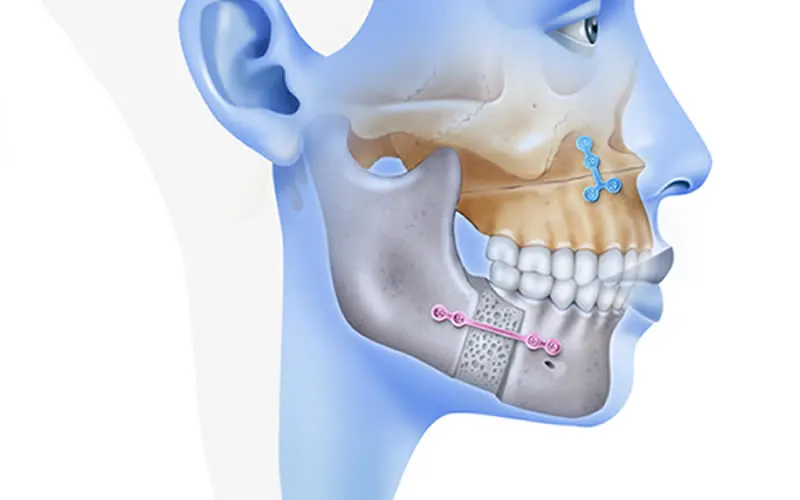
In modern jaw surgery, the primary medical procedure used to advance the lower jaw is a highly sophisticated operation called “Bilateral Sagittal Split Osteotomy”
(BSSO). One of its greatest advantages is that it leaves no external incision (scar) marks on the face, cheeks, or neck. The entire surgical procedure is performed
intraorally. With a meticulous millimeter-level plan that avoids injury to nerve tissues, the mandible is released horizontally and vertically from the posterior angle
(angulus) region. The mandibular body—together with the teeth—is then slid forward like a drawer until it reaches the ideal occlusion (bite) point that was
predetermined in the virtual plan. The new bone position is permanently stabilized using biocompatible titanium mini plates and screws. Thanks to the body’s natural
bone-healing capacity (osteogenesis), the gap created between segments fuses over the following months with new and solid bone tissue.
The success of such a precise operation—one that changes the entire dynamic of the face—cannot be left to chance with traditional methods. Dentocare Clinic applies
two core, technology-based safety protocols in these procedures, leaving no room for error:
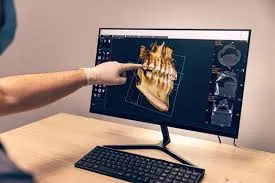
- 3D Virtual Surgical Simulation: Using the patient’s CT data, the exact number of millimeters the mandible will be advanced is designed in a digital
environment. This allows the surgeon to “perform” the operation virtually with millimeter precision before entering the operating room, eliminating surprises. - Multidisciplinary Orthodontic Adaptation: Before surgery, the orthodontist and maxillofacial surgeon work in synchronized coordination at every
stage to align the teeth with the future jaw position (decompensation) and, after surgery, to ensure the jaw locks into its new position flawlessly.
Post-Operative Recovery: Rebirth and a Higher Quality of Life
One of the first things most patients say upon waking from mandibular advancement surgery is not about the aesthetic change, but the fact that they “can breathe this
deeply and comfortably for the first time in their lives.” As the jaw is advanced, the tongue base moves away from the throat, and airway volume typically increases
two to three times compared to preoperative levels. This mechanical relief eliminates sleep apnea syndrome; because the patient receives uninterrupted oxygen through
the night, they begin waking with high energy. After the first few weeks of a liquid and soft diet, decreasing facial swelling completely transforms the reflection in
the mirror. The vague transition between the neck and the underside of the chin is replaced by a highly defined, sharp, and strong jawline profile.
Mandibular retrusion is a heavy skeletal burden that exhausts the individual physically and restricts self-expression psychologically. It is not possible to reduce or
camouflage this burden with poorly planned orthodontic treatments. Perfect tooth contact, the freedom to breathe during sleep, and achieving the strong aesthetic
character inherent in your face can only be accomplished through a definitive skeletal repositioning.