
Kahramanmaraş Bite Disorder Surgery: Functional and Aesthetic Transformation with Dentocare Clinic
Expert Physician Staff Statement: “Malocclusion is not merely a cosmetic alignment issue of the teeth; it is a skeletal disease of the jaw bones. The surgical protocols we apply at Dentocare Clinic aim to increase respiratory capacity, reduce the burden on the digestive system, and permanently reconstruct the golden ratio of the face.”
Why Can’t Bite Disorders Be Treated With Braces Alone?
One of the biggest questions in many of our patients’ minds is why orthodontic treatment (braces) alone is not sufficient. While jaw guidance appliances may be used in children whose bone development is not complete, in adults whose growth plates have closed (18+ years), the size, angle, and position of the jaw bones are fixed. If your lower jaw is anatomically 1 cm longer than your upper jaw or your upper jaw is significantly narrower than normal, moving teeth within the bone only masks the skeletal problem rather than solving it.
Even if the teeth are properly aligned, the bone bases remain in the wrong position, preventing proper lip closure, maintaining abnormal jaw posture, and continuing to place incorrect pressure on the joints during chewing.
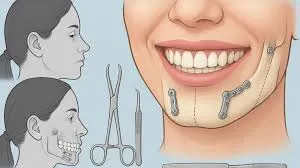
This is where orthognathic surgery comes into play. At Dentocare Clinic, our orthodontists and maxillofacial surgeons work side by side. Teeth are first aligned according to the surgical plan (decompensation). Then, during surgery, the bones are repositioned and fixed with titanium plates and screws. This multidisciplinary approach provides both perfect dental occlusion and ideal facial aesthetics. Especially in severe skeletal cases from Kahramanmaraş and surrounding provinces, we achieve not only aesthetic but also significant functional relief.
Main Skeletal Bite Disorders Requiring Surgical Intervention
The malocclusion types frequently encountered in clinical practice and requiring surgical indication affect patients’ quality of life in different ways. At Dentocare Clinic, our diagnostic and treatment approach is based on the following scientific classifications:
| Skeletal Disorder Type | Physical and Functional Symptoms | Surgical Procedure Applied (Orthognathic Intervention) |
|---|---|---|
| Skeletal Class II (Lower Jaw Deficiency / Upper Jaw Protrusion) | Severely recessed lower jaw profile, difficulty in nasal breathing, sleep apnea (snoring), protruding front teeth, and inability to close the lips. | Mandibular Advancement Surgery (BSSO). The lower jaw bone is cut at special angles and moved forward, instantly expanding the airway. |
| Skeletal Class III (Lower Jaw Protrusion / Upper Jaw Deficiency) | Known as “bulldog jaw” appearance. Lower teeth overlapping upper teeth, inability to bite with front teeth. | Double Jaw (Bimaxillary) Surgery. If necessary, the upper jaw (Le Fort I osteotomy) is advanced while the lower jaw is repositioned backward symmetrically. |
| Open Bite (Skeletal Open Bite) | Front teeth remain open while posterior teeth are in contact. Difficulty biting food, lisping of “s-z” sounds, and mouth breathing. | Maxillary Impaction Surgery. The upper jaw is surgically repositioned upward, allowing natural occlusion of the front teeth. |
| Gummy Smile (Excessive Gum Exposure) | Excessive gum display during smiling due to vertical overgrowth of the upper jaw bone, causing aesthetic imbalance. | Maxillary impaction by removing a horizontal bone segment from the upper jaw and repositioning it upward. Smile aesthetics are permanently balanced. |
Dentocare Clinic Bite Disorder Surgery Stages
We are fully aware that such a major step is both exciting and filled with uncertainties for our patients. Transparency and trust between doctor and patient are the most critical elements of treatment success. The surgical protocol at Dentocare Clinic consists of the following main steps:
- Comprehensive Medical Analysis and 3D Planning: In the first stage, 3D dental tomography scans are taken by our specialist physicians. Advanced software simulates bone movements virtually before surgery. Patients can preview how their face will look after surgery.
- Orthodontic Preparation (Pre-Surgical Braces Treatment): Teeth must be aligned properly on the bone for perfect surgical results. This process takes approximately 6 to 12 months. Teeth are positioned like a puzzle that will perfectly fit once the jaws are repositioned.
- Surgical Operation and Recovery (Post-Op): The procedure is performed under general anesthesia in a fully equipped operating room. Since all procedures are done intraorally, no external surgical scars remain on your face. The jaws fixed with titanium materials are supported with a soft/liquid diet in the early weeks.
The first few weeks after surgery are critical for the reduction of natural facial swelling and adaptation of tissues to their new positions. During this period, our specialist physicians provide continuous follow-up, offering personalized guidance on nutrition, oral hygiene, and joint exercises.
Make the Life-Changing Decision Today
Living with chewing difficulties, sleep disorders, and aesthetic concerns is not a necessity. Rediscover the golden ratio of your face with advanced medical technology and experienced specialist physicians at Dentocare Clinic in Kahramanmaraş. We are here for a healthy bite, strong breathing, and a perfect profile.







