
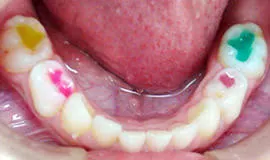
What Happens If a Filled Baby Tooth Falls Out?
Considering the effort, time, and financial resources parents invest in their children’s dental treatments, the “permanence” of a procedure is understandably one of the greatest expectations. You went to a pedodontics (children’s dentistry) clinic to treat your child’s decayed tooth, perhaps went through a difficult process, and had a filling done. However, after a while, that tooth started to loosen or fell out completely. At that moment, the first question that comes to mind for parents is: “We had a filling done, but the tooth fell out, was our treatment wasted?” or worse, “Did it fall out prematurely because of the filling?”
These concerns are perfectly natural, but from the perspective of dental principles, the situation is generally nothing to fear. Baby teeth have a biological lifespan, and when this lifespan ends, whether or not they have a filling, it is an expected and healthy process for the tooth to fall out. However, sometimes only the filling may fall out, or the tooth may be lost prematurely.
The Natural Journey of a Baby Tooth and the Role of Fillings
Baby teeth are guides for the permanent teeth developing underneath them. When the time comes, the permanent tooth underneath moves upwards, eroding (resorbing) the roots of the baby tooth and causing it to fall out. This is a physiological (natural) process.
Having a filling in a baby tooth does not stop, slow down, or speed up this natural process. The filling is only done on the “crown,” the part of the tooth visible in the mouth. The erosion process in the roots continues independently of the filling. Therefore, if a filled baby tooth loosens and falls out when the time comes, it does not mean that the treatment has failed. On the contrary, it shows that the tooth has successfully completed its task by remaining in the mouth until its time to fall out. The purpose of a filling is not to keep the tooth there forever, but to ensure it remains healthy in the mouth until the age at which it falls out (e.g., 10-12 years for molars).
Scenario 1: The Filled Tooth Falls Out When It’s Time to Fall Out
This is the ideal scenario. If your child’s age is compatible with the age at which the tooth falls out (e.g., 6-7 years for front teeth, 10-12 years for back teeth) and the filled tooth loosens and falls out, there is nothing to worry about.
When you pick up the fallen tooth, you may see that it has no root, appears hollow, and the filling material is still in place. This signals that the treatment has achieved its purpose, fulfilled its function as a space maintainer, and the permanent tooth underneath will erupt healthily.
Scenario 2: Premature Tooth Loss
If a filled tooth falls out much earlier than its scheduled time (for example, a tooth that should fall out at age 10 falls out at age 5) due to impact, trauma, or infection, the situation is different. This is an unwanted premature loss.
Risks: The adjacent teeth begin to shift into the space left by the prematurely lost baby tooth. This closes the space for the permanent tooth that will erupt from below, causing it to remain impacted or erupt crooked.
Solution: In such a case, you should consult your dentist immediately. Your dentist will recommend a simple appliance called a “Space Maintainer” to preserve that space.
Scenario 3: What if Only the Filling Falls Out, Not the Tooth?
Sometimes the tooth is in place, but the filling material on it may fall out or break. This situation is completely different from a tooth falling out and requires intervention. Reasons for fillings falling out may include:
- Moisture Control: Children have difficulty controlling their saliva. Moisture in the tooth during filling placement can weaken the adhesion of the filling.
- Hard/Sticky Foods: Sticky candies like jellybeans and gum, or very hard nuts, can dislodge the filling.
- Teeth Grinding (Bruxism): Some children clench their teeth excessively in their sleep; this force can break the filling.
- Secondary Cavities: If a new cavity starts at the edge of the filling, the support of the filling is lost and it falls out.
What to Do? If only the filling has fallen out, the sensitive tissues inside the tooth are exposed. This causes pain and food accumulation. You need to see your dentist to have the filling replaced.
Situation Analysis Table
The following table serves as a guide for parents to more clearly distinguish the situation:
| Event | Timing | Comment | What to Do |
|---|---|---|---|
| Falling Out of Filled Tooth | Age Appropriate (Normal) | Great! Task completed. | Monitor the eruption of the permanent tooth. |
| Falling Filled Tooth | Too Early (Trauma, etc.) | Risky (Loss of Space). | Consult a dentist (A space maintainer may be needed). |
| Falling Filling Only | Any Time | Problematic (Tooth exposed). | Filling must be replaced. |
| Breakage of Filling | At any time | Disturbing. | Sharp edges should be trimmed or replaced. |
Is Swallowing a Filled Tooth Dangerous?
Children often swallow their teeth unintentionally while eating or sleeping when their teeth are loose. If the swallowed tooth has a filling, parents may be concerned about the chemical hazard of the filling material.
Reassuring Information: Filling materials used in dentistry (composites, compomers) are biocompatible and “inert” (non-reactive) materials. Stomach acid cannot dissolve this filling. A swallowed filled tooth is naturally eliminated from the body through the digestive system. There is no risk of poisoning. However, the risk of the tooth entering the trachea (aspiration) should always be taken seriously; If coughing fits occur, immediate emergency medical help should be sought.
Myths and Facts
Myth: “A filled tooth is harder to fall out, its roots don’t erode.”
Fact: A filling does not affect the root erosion process of a tooth. The roots of a baby tooth erode under the pressure of the permanent tooth coming from below. The filling is only on the top.
Myth: “If a filling falls out, the tooth needs to be extracted.”
Fact: No, if the filling falls out and the tooth is not yet due to fall out, the filling is replaced. Extraction is a last resort.
Important Note for Parents
When your child’s filled tooth starts to loosen, it is best to let this process take its natural course. Trying to pull the tooth out by force, tying it with string, or using hard objects can cause trauma and infection to the gums. If a loose tooth is preventing your child from eating, or if it has been loose for a long time without falling out, you can ask your dentist to remove the tooth using a “topical anesthetic” (spray/gel). This is the least traumatic method for the child.
Conclusion
The falling out of a filled baby tooth is often not a sign of treatment failure, but a natural result of the biological process. The important thing is the “timing” of this fallout. If the tooth falls out at the age it should, it means that thanks to the filling, it has remained in your child’s mouth until that age, aiding in feeding and holding space for the permanent tooth underneath. This is a pedodontic success story. However, in cases of early loss or simply when the filling falls out, staying in contact with your dentist to take preventative measures is critical for your child’s oral health.







